

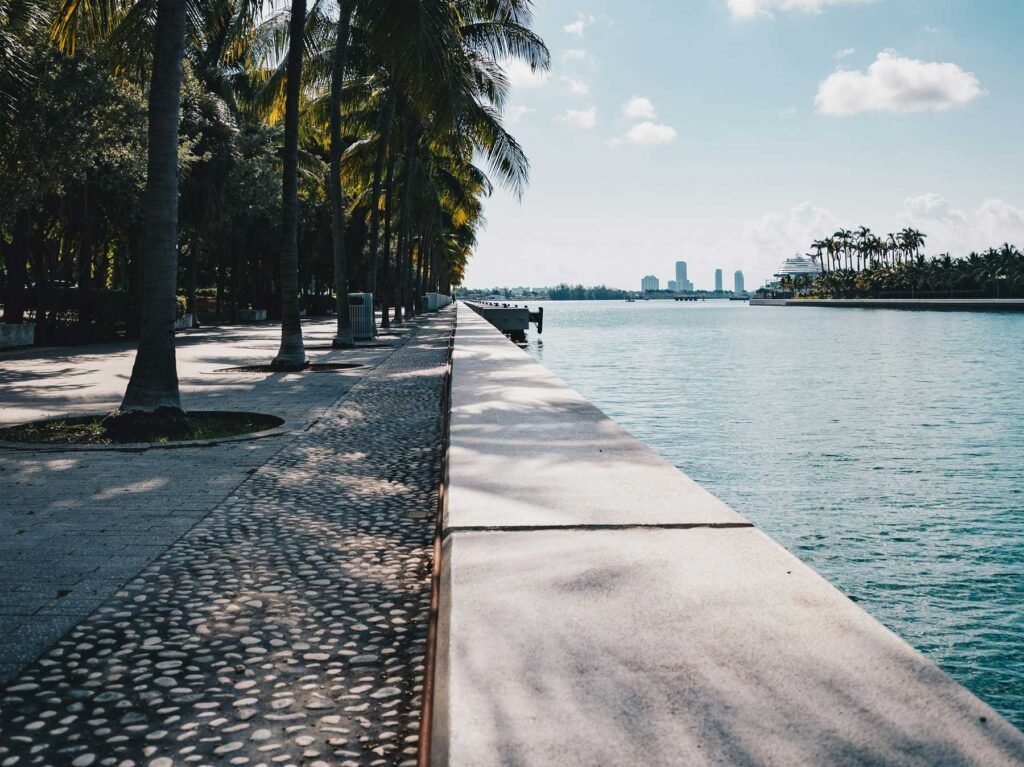
Keystone Point — also known as the Keystone Islands — is a gated community of 880 single-family homes built across a series of finger islands and canals off Biscayne Bay in North Miami. It is the largest concentration of canal-front single-family housing in the county that is not on a barrier island, and it is consistently the answer to a question a lot of Miami buyers ask badly: where can I own a house with a dock without paying Miami Beach prices?
- 880 single-family homes in a gated community — no condominiums, no towers
- Finger-island and canal layout with access to Biscayne Bay
- City of North Miami — a separate municipality with its own tax rate and services
- The Biscayne Canal was dug in 1924 “to reduce flooding of farmland”
- Active homeowners association (KPNA), elected and meeting monthly
- Site history running back to a Tequesta settlement, roughly 400–1200 A.D.
The history, which is older than Miami
This stretch of the mainland was inhabited by the Tequesta from roughly 400 to 1200 A.D., drawn by Arch Creek and its natural limestone bridge — a genuine geological arch spanning the creek. That bridge survived until 1973, when it collapsed shortly after efforts to bring it into state ownership were finalised. It is one of the more quietly sad footnotes in Miami-Dade’s preservation record.
Eighteen homes and two tomato packing houses
A railroad depot arrived in 1903. By 1912 the settlement here comprised “eighteen homes, a church, a general store, a blacksmith shop, and two tomato packing houses” — an agricultural community, not a resort one. The Biscayne Canal was dug in 1924 for the unglamorous purpose of draining farmland, and during the 1920s land boom portions of the area were “subdivided and sold to northern tourists as residential lots.”
Why the municipality shows up on your tax bill
The municipal history is worth knowing because it still shows up on a tax bill. The Town of Miami Shores was incorporated in 1926 covering this area, and it later became part of North Miami in 1952. Keystone Point is therefore in the City of North Miami — not the City of Miami, not Miami Shores Village, and not unincorporated Miami-Dade. Millage, permitting, police and code enforcement all run through North Miami.
What you are actually buying
The product here is specific and it is not for everyone.
What 880 houses and nothing else produces
Keystone Point is 880 houses and nothing else. No condominium towers, no commercial frontage inside the community, no rental buildings. The layout is a set of peninsulas and islands cut by canals, so a very high proportion of the housing stock is waterfront or one lot from it — a ratio that essentially no other mainland Miami-Dade neighbourhood matches at this scale.
The housing stock, and its range of condition
The housing stock is predominantly post-war and mid-century in origin, which means two things. First, a meaningful share of what trades has been renovated, extended or rebuilt, and the range of condition is enormous — original 1950s ranch houses sit beside recent rebuilds on the same canal. Second, the lots are generous by modern standards, because they were platted when land here was cheap.
The gate and the association
The gate and the active association are part of the value. KPNA is described as “a duly elected group of volunteers that work to preserve and improve our NEIGHBORHOOD, QUALITY OF LIFE & PROPERTY VALUES,” meets monthly, and represents the community to local government. In a neighbourhood of 880 owner-occupied houses, that is a functioning civic body rather than a nominal one.
The boating question — ask it correctly
Most buyers looking at Keystone Point are here because of the water, and most of them ask the wrong question. “Is it waterfront?” is nearly meaningless in a canal community. The questions that determine whether the property works are these:
- What is the route to open water, and what is the lowest fixed clearance on it? This is the single number that decides which boats can live at the house. Establish it for the specific vessel, in writing, before you buy either the house or the boat. A dock you cannot leave is a patio.
- What is the controlling depth at mean low water, in the canal and at the dock? Canals silt. Depth on a listing is often depth at high tide, quoted optimistically.
- Seawall condition and remaining life. The most consequential deferred-maintenance item in any canal neighbourhood, routinely a six-figure replacement, and frequently invisible at a walkthrough. Get it inspected specifically — a general home inspector will not assess it properly.
- Dock, davit and lift permitting. What exists, what was permitted, and what was not. Unpermitted marine structures become the buyer’s problem at resale, not the seller’s.
- Flood zone, elevation certificate, insurance quote. In that order, before the inspection period closes. On mid-century canal-front stock this is often the number that decides the deal.
- Roof age, and whether the house has been re-piped and re-wired. Original 1950s systems are common here, and insurers price them accordingly — or decline them.
The value case, stated honestly
Keystone Point’s argument is arithmetic. You are buying a single-family house, on a canal, with a dock, behind a gate, in a community of owner-occupiers — and you are doing it on the mainland in North Miami rather than on a barrier island. The same brief on Miami Beach, Bal Harbour or Key Biscayne is a materially different number.
The trade-offs, named
The trade-offs are real and should be named:
- Bridge clearance limits vessel size in most of the canal neighbourhoods on this side of the bay. Buyers with large sportfish or a flybridge need this resolved first, not last.
- North Miami is not Miami Beach in services, schools or street-level amenity, and pretending otherwise does a buyer no favours. The commute to Aventura, the Design District and Miami Beach is straightforward; the neighbourhood itself is residential and quiet by design.
- The housing stock is old. Budget for a roof, systems and possibly a seawall on anything that has not already been comprehensively renovated.
For a buyer who wants water access and a house rather than a view and a unit, that trade is frequently the right one — and it is available at Keystone Point at a scale that simply does not exist elsewhere on the mainland.
Market context
This is a single-family market, currently the strong half of a divided county.
Miami-Dade single-family, June 2026
In June 2026, Miami-Dade single-family homes posted a median of $695,000, up 3.7% year over year, on 1,049 closed sales — up 16.8%. Active listings fell 22.7% to 4,380, leaving 4.9 months of supply. Cash accounted for 27.6% of closings.
Condominiums, same county and month: 11,550 active listings, 12.3 months of supply, median down 3.1% to $431,000, 48.5% cash. One county, two opposite markets — and Keystone Point sits entirely on the tight side of it.
Within the neighbourhood, expect wide dispersion. An unrenovated 1950s house on an interior lot and a rebuilt house on a wide canal with a new seawall are not the same asset, and per-foot averages across 880 homes will mislead in both directions.
Who it suits
Keystone Point suits a boat owner who wants a house, a family that wants a gated single-family street, and a buyer who understands that the value here is in the water access and the land rather than in the building they are inheriting. It rewards people who do the seawall and clearance homework and punishes people who do not.
It is the wrong neighbourhood for someone who wants walkable amenity, new construction at scale, or a barrier-island address.
If you are looking at a Keystone Point property and want the seawall, clearance, permitting and insurance position established before the inspection period closes, that is the work worth doing first. See also Miami waterfront listings, Miami Shores and every Miami neighbourhood we cover.
Related reading: waterfront houses on the Miami River · homes from $500,000 to $1 million · market reporting in The Miami Confidential.
Keystone Point, North Miami — common questions
How many homes are in Keystone Point?
880. The Keystone Point Neighborhood Association describes it as “a gated community that consists of 880 single-family homes.” There are no condominiums or rental towers inside the community, which makes it one of the largest all-single-family gated waterfront neighbourhoods on the Miami-Dade mainland.
Is Keystone Point gated?
Yes. It is a gated community with an active, elected homeowners association — KPNA — which meets monthly and represents the neighbourhood to local government. Keystone Point is within the City of North Miami, so permitting, police, code enforcement and the tax rate run through that municipality.
Can I keep a boat at a Keystone Point home?
Many properties have canal frontage and dockage, but the binding constraint is usually the lowest fixed bridge clearance on the route to open water, followed by controlling depth at mean low water. Both should be established for your specific vessel before you buy the house. Also confirm seawall condition and remaining life, and whether existing docks, davits and lifts were permitted — unpermitted marine structures become the buyer’s problem at resale.
What is the history of Keystone Point?
The area was a Tequesta settlement from roughly 400 to 1200 A.D., centred on Arch Creek and its natural limestone bridge, which collapsed in 1973. A railroad depot arrived in 1903, and by 1912 the community had “eighteen homes, a church, a general store, a blacksmith shop, and two tomato packing houses.” The Biscayne Canal was dug in 1924 to reduce farmland flooding, and the 1920s boom brought residential subdivision. The Town of Miami Shores was incorporated in 1926 and became part of North Miami in 1952.
Is Keystone Point a good value compared with Miami Beach?
That is its central argument. You are buying a gated, single-family, canal-front house on the mainland rather than a barrier island, and the pricing reflects that. The honest trade-offs are bridge clearance limiting vessel size, older housing stock requiring roof, systems and sometimes seawall investment, and a residential rather than walkable-amenity setting. For a buyer who wants water access and a house rather than a view and a unit, it is frequently the right trade.
What should I budget for beyond the purchase price?
On mid-century canal-front stock, plan for the possibility of a roof, re-piping, re-wiring and a seawall. Seawall replacement in particular is routinely a six-figure item, is not assessed properly by a general home inspector, and is often invisible at a walkthrough. Get the elevation certificate and an actual insurance quote before the inspection period closes — on this housing stock, insurance is frequently the number that decides the deal.
Sources and further reading
- Keystone Point Neighborhood Association — Aboutkeystonepoint.net
- MIAMI REALTORS — South Florida Market Stats, June 2026miamirealtors.com
Related coverage
Part of Neighborhoods.