

Miami Luxury Condos · South Beach · Monad Terrace
59 residences across 14 floors.
By Josh Stein · Florida license SL3057661 · Updated 10 October 2026Leer en español →
1 condo for sale at Monad Terrace, list price $1,817.98 per sq ft.
- Asking range$4,125,000
- List price per sq ft$1,817.98
- Sold, 12 months0


Listing information is deemed reliable but is not guaranteed and is provided exclusively for consumers' personal, non-commercial use. Data is supplied by the MLS and may be subject to change or withdrawal without notice.
Last updated 1 second ago
Key facts about Monad Terrace
| Address | 1300 Monad Terrace, Miami Beach FL 33139 |
|---|---|
| For sale now | 1 |
| List price range | $4,125,000 |
| Size | 2,269 sq ft |
| Bedrooms | 3 BR |
| List price per sq ft | Average $1,817.98, low $1,818, high $1,818 |
| Monthly HOA | $2,118 to $5,818 |
| Year built | 2021 |
| Amenities | Bike Storage, Elevators, Fitness Center, Library, Maintenance Grounds, Management, Parking, Picnic Area, Pool, Spa Hot Tub, Trash |
| Neighborhood | Miami Beach |
Residences at Monad Terrace
| Bedrooms | For sale | Size (sq ft) | List price | Avg $/sq ft | Last sale |
|---|---|---|---|---|---|
| 2 | 0 | $1,762,500 (July 14, 2025) | |||
| 3 or more | 1 | 2,269 | $4,125,000 | $1,817.98 | $4,150,000 (April 16, 2025) |
Recently sold in
4 listings


Verified 23 September 2026JDS Development Group, Florida Statute 553.899, Fannie Mae +1 more4 sources
Key Takeaways
- Monad Terrace recorded 8 sales in the 12 months to 23 September 2026 — at a median of $4,075,000, or $1,797 per square foot, on the Miami-Dade County Property Appraiser record. The latest recorded sale was on 13 August 2026. Own at Monad Terrace? Ask Josh what yours would sell for on WhatsApp.
- 59 residences across 14 floors at 1300 Monad Ter., and the county roll carries 60 residential folios.
- Status: Delivered — completed 2021 — verified against the county roll and the development trade record.
- Developed by JDS Development Group.
- Architecture by Ateliers Jean Nouvel.
- Year built: 2021.
Monad Terrace, by the numbers
Developer: JDS Development Group · Architect: Ateliers Jean Nouvel. Source: the building record on this site.
Have a question about Monad Terrace? This page is built from the county record and the trade press, not a listing feed. If you want what has actually closed here, or an honest read on whether it suits you, ask me directly.
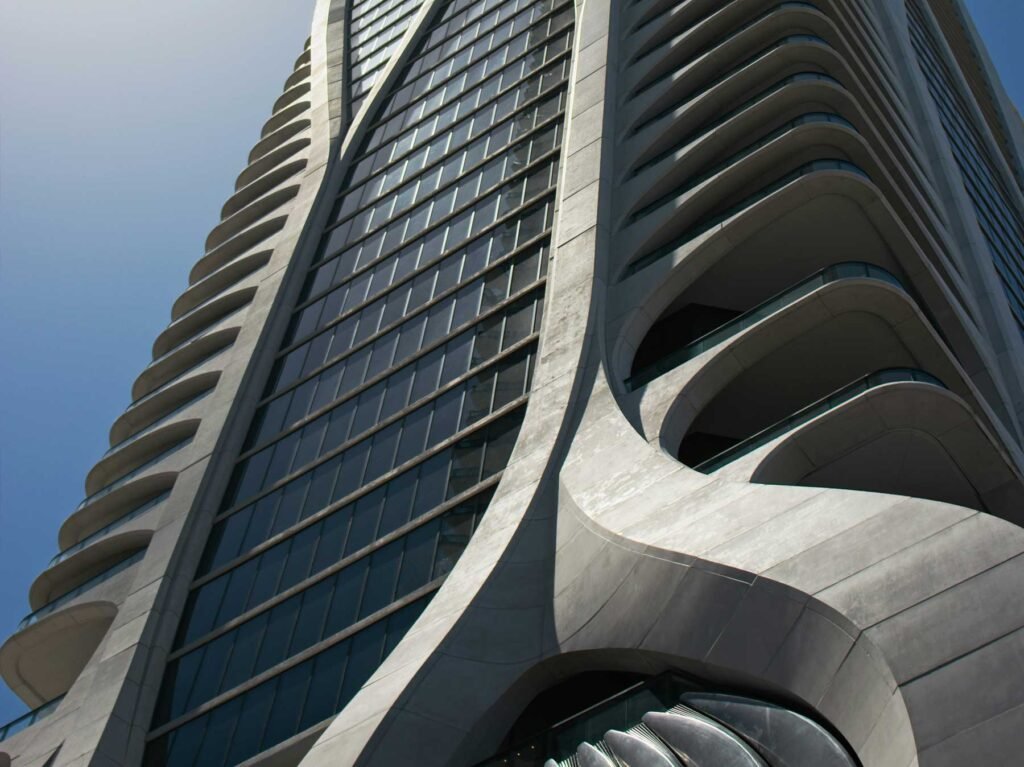
Monad Terrace is 59 residences by Ateliers Jean Nouvel on the bay side of South Beach — a building organised around a central lagoon, wrapped in a sawtooth aluminium curtain wall designed to catch and scatter light off the water. It is one of the smallest of the recent starchitect buildings in Miami Beach, and its design idea is easy to read from the street.
- 1300 Monad Terrace, Miami Beach — West Avenue corridor, Biscayne Bay side
- 59 residences — one of the smallest luxury buildings on the Beach
- Design architect Ateliers Jean Nouvel; executive architect Kobi Karp
- Height approximately 173 feet
- Developer JDS Development Group; topped off February 2019
- Central lagoon, infinity-edge pool and a 116-foot swimming pool with hot tub over the bay
- Dock access — rare in a South Beach condominium
The design idea
Nouvel’s stated ambition for the project was characteristically large: “With one building you can change the nature of a place.” The organising inspiration was narrower and better — “the reflection of the sun on the water.”
The sawtooth facade
That single idea drives the whole building. The façade is a honeycomb aluminium curtain wall with a sawtooth profile that, in the developer’s description, “captures, diffuses, and reflects incoming lights, simultaneously framing views and providing privacy.” The angled faces mean the building never presents a flat glass wall to the street or the bay; it breaks light up rather than mirroring it back. In practice this does two things a conventional glass tower cannot: it reduces the sheet-of-glare effect that makes so many Miami buildings unpleasant to stand next to, and it gives each residence oblique privacy from its neighbours without curtains.
The lagoon
The ground plane carries the second half of the idea. Rather than a lobby with a pool deck behind it, the building is arranged around a central lagoon with sun decks and integrated planters, an infinity-edge pool, and a 116-foot pool with hot tub facing Biscayne Bay. The landscape was designed by Ateliers Jean Nouvel itself, with Kimley-Horn as engineer of record — meaning the architect controlled the water and planting rather than handing them to a separate consultant. It shows.
Why 59 residences matters
Scarcity in Miami Beach is usually claimed and rarely real. Here it is arithmetic.
What 59 residences produces
Fifty-nine residences is a very small number for a building of this height and land value. The consequences run through everything a buyer experiences:
- Very low transaction volume. In a typical year only a handful of units trade, which means comparables are scarce and pricing requires judgement rather than a per-foot average.
- Amenity ratio. A 116-foot pool, a lagoon, a residents’ lounge and a wellness centre shared across 59 households is a fundamentally different experience from the same facilities across 400.
- Association arithmetic cuts both ways. Fixed building costs — insurance, façade maintenance, reserves, the water features — are divided across 59 owners rather than several hundred. Per-unit carrying costs in small luxury buildings are structurally higher, and buyers coming from larger towers are routinely surprised. This is not a defect; it is the price of the ratio above. But it must be modelled, not assumed.
That last point is a common miscalculation in boutique-building purchases, and it deserves to be run properly before an offer rather than discovered at the first budget.
Bay side, not ocean side — and why that is a choice, not a compromise
Monad Terrace sits on the West Avenue corridor, facing Biscayne Bay. Buyers conditioned to treat oceanfront as automatically superior should understand what the bay side actually delivers.
What the bay side delivers
You get sunsets rather than sunrises, over the water rather than over rooftops — which, for anyone who is actually home in the evening, is the view that gets used. You get the downtown Miami skyline as the backdrop. You get protected water and, critically here, dock access — an amenity that essentially does not exist in oceanfront South Beach condominiums, because there is nowhere to put a boat. And you get a shorter, easier route to Sunset Harbour, Lincoln Road and the causeways.
What you give up is the Atlantic horizon and direct beach access on foot. That is a real trade and different buyers should land differently on it. But a boat owner who wants a South Beach condominium has very few options, and this is one of them.
Diligence — what actually matters here
- Model the per-unit carrying cost properly. Fifty-nine owners carry the whole building. Get three years of budgets and the current assessment schedule, and compare the monthly against buildings you are also considering — not against the sticker price.
- Ask what the water features cost to run. A lagoon, an infinity edge and a 116-foot pool are mechanical systems with pumps, filtration, treatment and eventual replacement. They are a permanent line item, and in a 59-unit building they are not diluted.
- Ask about the curtain wall maintenance programme. A sawtooth honeycomb aluminium façade is beautiful and it is bespoke. Bespoke envelopes are more expensive to clean, seal and eventually repair than standard systems, and replacement parts are not off-the-shelf. Find out what the reserve study assumes for it.
- Confirm the dock arrangement precisely. Is dockage assigned, deeded, licensed or first-come? What vessel sizes are accommodated, what is the controlling depth, and what does the route to open water clear? Dock rights are frequently the reason someone buys here and frequently the thing least well documented.
- Pull the flood zone and elevation certificate before the insurance quote. This is a bayfront site on the West Avenue corridor. Insurance and resilience are material, and both should be resolved in numbers rather than assurances.
- Get the Structural Integrity Reserve Study alongside the budget. The SIRS says what the building needs; the budget shows whether it is funded. The gap is the future assessment.
Where does Monad Terrace stand on its milestone inspection?
Under Florida Statute 553.899, a condominium or cooperative building of three or more habitable stories must complete a milestone structural inspection by 31 December of the year it turns 30, then every 10 years. § 553.899(3)(b) lets the local enforcement agency shorten that clock where local circumstances — expressly including “proximity to salt water” — warrant it.
The milestone date
Miami-Dade County has exercised that discretion, putting coastal buildings completed in 1998 or later on a 25-year clock. But the City of Miami Beach administers its own recertification programme, and the City publishes a 30-year threshold measured from the original certificate of occupancy. That distinction is worth five years on this building.
Monad Terrace topped off in February 2019 and completed shortly after. On the City’s published 30-year threshold, that places its first milestone inspection in the early 2050s on the county’s 2021 build year; the certificate-of-occupancy date controls. Topping off is not a certificate of occupancy, and the certificate date is the figure that legally controls — confirm it, and confirm which agency’s threshold governs, from the record.
That is roughly a quarter century of runway, and in the current market it is worth real money. A great deal of Miami Beach’s condominium stock is in the milestone cycle now, discovering deferred maintenance and assessing for it. A building with a modern envelope, a funded reserve study and no milestone obligation until the early 2050s (on the county’s 2021 build year; the certificate-of-occupancy date controls) is in a structurally different position — and increasingly, lenders price that difference.
Financing context
Since 3 August 2026, Fannie Mae’s Lender Letter LL-2026-03 has retired the Limited Review path for established projects over ten units, so Full Review now applies at every down-payment level. A master policy deductible above $50,000 per unit breaks eligibility, and from 4 January 2027 minimum reserves rise from 10% to 15% of annual budgeted assessment income.
In June 2026, 48.5% of Miami-Dade condominium sales closed in cash, and the county carried 12.3 months of condominium supply with a median down 3.1%. In that market a project’s review status is a price input. Newer, well-reserved buildings clear it; older, under-reserved ones increasingly do not, and become cash-only.
The honest summary
Monad Terrace is a serious piece of architecture — Nouvel controlling the façade, the landscape and the water together, at a scale of 59 residences that keeps it genuinely scarce, with dock access that South Beach oceanfront cannot offer and about twenty-five years before its first milestone.
The costs are the mirror image of the virtues: a bespoke envelope and elaborate water features carried by a small number of owners. That is not a reason to avoid the building. It is a reason to underwrite the association’s budget as carefully as the unit, which in 2026 is the correct order of operations everywhere.
See also South Beach, Miami Beach as a whole and the wider Miami condo market.
Related reading: Aqua on Allison Island · Roney Palace on Collins Avenue · Belle Isle off the Venetian Causeway.
Own at Monad Terrace?
If you own here, this page already carries the county’s record of what homes in Monad Terrace have sold for. Here is how to use it.
Your three options
- Sell. Price against what comparable homes in the building have actually recorded, not against asking prices.
- Rent it out. Within the condominium’s rental rules, which vary from building to building.
- Hold. Watch the record: this page is updated from the county as new sales are posted.
What I will send you
Tell me your unit. I will send you the recorded sales of comparable homes in Monad Terrace, what they sold for per square foot, and a straight read on what yours could sell for today.
Two free things for owners
Monad Terrace — common questions
What have homes at Monad Terrace sold for in the last 12 months?
8 sales were recorded on the Miami-Dade County Property Appraiser record in the 12 months to 23 September 2026, at a median of $4,075,000 ($1,797 per square foot). The latest recorded sale was on 13 August 2026. These are recorded closings, not asking prices. If you own at Monad Terrace and want to know what your home would sell for, message Josh Stein on WhatsApp at (305) 695-8257.
Who designed Monad Terrace?
Ateliers Jean Nouvel was the design architect, with Kobi Karp as executive architect. Nouvel’s practice also designed the landscape, with Kimley-Horn as engineer of record — an unusual arrangement that gave the architect control of the water features and planting as well as the building. The developer was JDS Development Group.
How many units are in Monad Terrace?
59 residences by the developer’s count (the county roll carries 60 residential folios), at a height of approximately 173 feet. That is a very small unit count for a building of this land value, which makes turnover low and comparables scarce — but it also means fixed building costs are divided across only 59 owners, so per-unit carrying costs are structurally higher than in a large tower. Model the monthly, not just the price.
What is the design concept at Monad Terrace?
Jean Nouvel took “the reflection of the sun on the water” as the organising idea. The façade is a honeycomb aluminium curtain wall with a sawtooth profile that “captures, diffuses, and reflects incoming lights, simultaneously framing views and providing privacy” — so the building breaks light up rather than mirroring it back. The ground plane is arranged around a central lagoon with sun decks and planters, an infinity-edge pool, and a 116-foot pool with hot tub facing Biscayne Bay.
Does Monad Terrace have boat dockage?
The building offers dock access, which is genuinely rare for a South Beach condominium — oceanfront buildings have nowhere to put a boat. Before relying on it, confirm precisely how dockage is held (assigned, deeded, licensed or first-come), what vessel sizes are accommodated, the controlling depth, and the clearance on the route to open water.
When is Monad Terrace’s milestone inspection due?
The early 2050s on the county’s 2021 build year; the certificate-of-occupancy date controls. That is on the City of Miami Beach’s published threshold. Florida Statute 553.899 sets the milestone structural inspection at 30 years for condominium buildings of three or more habitable stories, then every 10 years, and Section 553.899(3)(b) lets the local enforcement agency shorten that to 25 years where local circumstances such as proximity to salt water warrant it. Miami-Dade County has done so for coastal buildings completed in 1998 or later, but the City of Miami Beach runs its own recertification programme and publishes a 30-year threshold measured from the original certificate of occupancy. Monad Terrace topped off in February 2019 and completed shortly after, which places the first inspection in the early 2050s on the county’s 2021 build year; the certificate-of-occupancy date controls. Topping off is not a certificate of occupancy, and the certificate date is what legally controls.
Is bayfront better than oceanfront in South Beach?
It is a different product, not a lesser one. The bay side gives you sunsets over water rather than sunrises, the downtown skyline as a backdrop, protected water, dock access, and easier access to Sunset Harbour, Lincoln Road and the causeways. You give up the Atlantic horizon and walk-out beach access. For a boat owner who wants a South Beach condominium, the bay side is effectively the only option.
Sources and further reading
- JDS Development Group — Monad Terracejdsdevelopment.com
- Florida Statute 553.899 — Mandatory structural inspectionsflsenate.gov
- Fannie Mae — Lender Letter LL-2026-03singlefamily.fanniemae.com
- MIAMI REALTORS — South Florida Market Stats, June 2026miamirealtors.com
Thinking about Monad Terrace?
I have sold South Florida property since 2002, more than $1 billion of it. Ask me for the recorded declaration, what has genuinely closed, or a straight answer on whether this building fits what you are after.
Josh Stein · Florida real estate sales associate, license SL3057661 · (305) 695-8257 · hello@joshsteinrealtor.comGet this building’s next recorded sale — before the listing sites catch up
- Every closed sale we can verify from the Miami-Dade record — price, date, and $/sqft when the deed supports it — not an IDX feed.
- Optional alert when a new deed posts in this building (or a short list of comps you choose).
- No spam inventory blasts. One building. One record. You decide what happens next.
Tell Josh which building. He’ll send the latest closed sales and set a quiet alert.
Get the sales recordRelated coverage
Part of Miami Luxury Condos.