

Neighborhoods · Journey's End
The Board of Architects — what it actually means in practice. Read off the public roll, not the listing feed.
By Josh Stein · Florida license SL3057661 · Updated 8 October 2026
- Asking range$159,900 to $172,500,000
- List price per sq ft$2,043
- Months of inventory5.5
- Sold, 12 months615


Listing information is deemed reliable but is not guaranteed and is provided exclusively for consumers' personal, non-commercial use. Data is supplied by the MLS and may be subject to change or withdrawal without notice.
Last updated 20 minutes ago
Recently sold in Coral Gables
4 listings


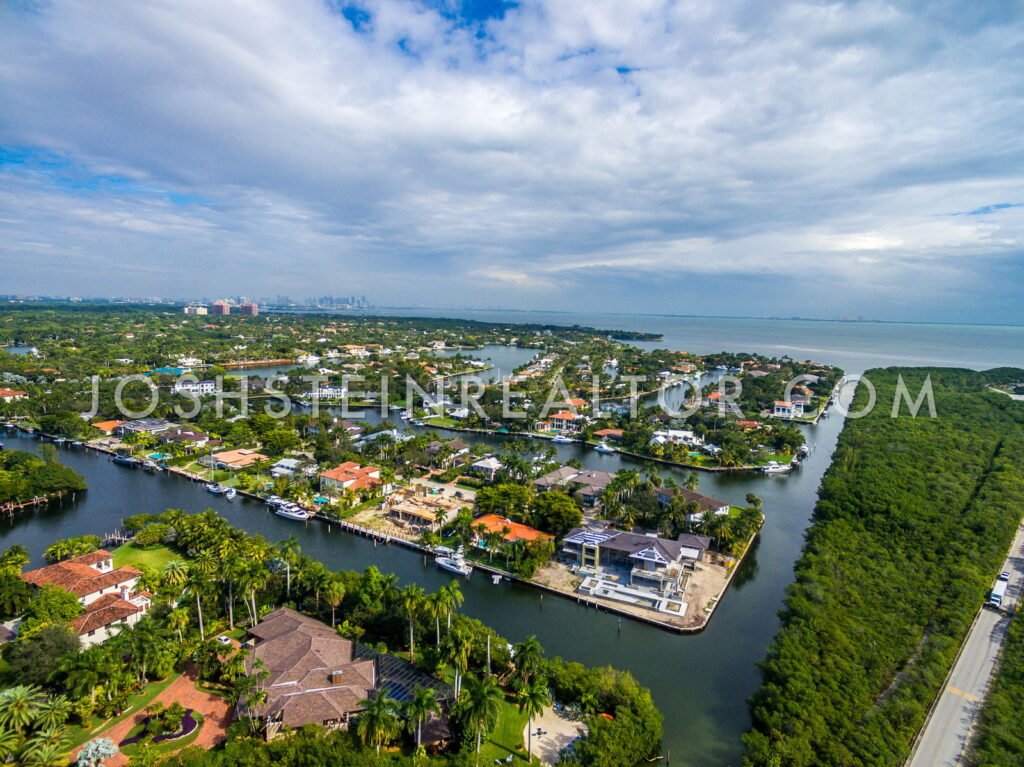
Aerial view of Journeys End in Coral Gables Condos and, Miami
Aerial view of Journey’s End, Miami
Journey’s End is a gated waterfront enclave in south Coral Gables, off Old Cutler Road, on the canal system that runs to Biscayne Bay. Buyers come for the water and the gate. What decides whether the purchase works is something almost nobody raises before an offer: in Coral Gables, you cannot build, extend, re-roof, repave or add a pool without going before the Board of Architects — twice.
- Gated waterfront enclave, City of Coral Gables — its own municipality, code and review process
- Canal frontage with access to Biscayne Bay — so clearance and depth decide vessel size
- Coral Gables Board of Architects review: preliminary and final approval before a permit issues
- At least seven local architects, appointed by the City Manager and approved by the City Commission; meets every Thursday morning
- Tree survey and tree protection plan required for Board submissions and demolition permits
The Board of Architects — what it actually means in practice
The Board was created, in the city’s own words, “to ensure that the city’s architecture is consistent with the city’s regulations and to preserve the community’s traditional aesthetics.” It is not an advisory body and it is not a formality.
What the Board actually reviews
Its remit is broad. The Board reviews “a wide variety of building and development applications such as new residences, new commercial structures, pools, pavement, signs, roof tiles, all building expansions, etc.” Read that list again: pools, pavement and roof tiles. Work that in most Miami-Dade municipalities is a permit counter transaction is, in Coral Gables, a design review item.
Preliminary, then final
The process for a typical permit “would involve a preliminary and final board approval prior to permit issuance.” Two appearances, not one. The Board “meets every Thursday morning,” which is frequent as these bodies go — but a preliminary-then-final sequence, with revisions between, is still measured in weeks to months rather than days. If the Board declines, “an appeal of the board’s decision is appeal to the City Commission.”
The tree survey comes first
And before any of that: a tree survey and a tree protection plan are required when presenting to the Board or applying for a demolition permit. On a mature south Gables waterfront lot, that is not a formality either — the trees frequently shape the buildable envelope.
Why this changes what you should offer
Most buyers price a Coral Gables waterfront house on land, water frontage and square footage, then plan a renovation as an afterthought. In this city that sequence is backwards.
- Time is the hidden cost. A preliminary and final review cycle, plus revisions, plus the tree plan, sits in front of every permit. If you need to occupy by a date, that calendar has to be built into the contract, not discovered after closing.
- Design freedom is bounded. The Board exists to preserve a traditional aesthetic. A buyer intending a hard-edged contemporary rebuild should test the concept with the Board’s expectations before committing, not after paying an architect for a full set.
- An existing compliant house has real option value. A property already approved and built to Gables standards saves the buyer the entire process. That is worth paying for, and it is routinely under-valued relative to a “teardown” priced on land alone.
The Med Bonus does not apply to single-family
One clarification worth making, because it is widely misunderstood: Coral Gables operates a “Med Bonus” programme that grants additional floor area and stories — 0.2 FAR plus one story at Level 1, 0.3 FAR plus one or two stories at Level 2 — for designs meeting its Mediterranean standards. The Zoning Code defines Mediterranean Architecture as “an architectural style that exhibits George Merrick’s vision.” But the Med Bonus thresholds are framed for multi-family and mixed-use buildings — six of eleven design requirements for multi-family, eight of eleven for mixed-use. A single-family buyer in Journey’s End is not accessing a density bonus; they are going through standard Board of Architects review. Do not let anyone tell you otherwise.
The water — ask the right question
Journey’s End sits on the south Coral Gables canal system with access to Biscayne Bay. As with every canal-front purchase in Miami-Dade, “is it waterfront?” is close to meaningless. These are the questions that decide whether the property does what you want it to do:
- The lowest fixed clearance on the route to open water. This single number determines which boats can live at the house. Establish it for the vessel you actually intend to keep — in writing, before the inspection period closes.
- Controlling depth at mean low water, in the canal and at the dock. Depth quoted on a listing is frequently depth at high tide.
- Seawall condition and remaining life. The most consequential deferred item on any canal property, routinely a six-figure replacement, and not properly assessed by a general home inspector. Commission it separately.
- Dock, davit and lift permitting. What exists, what was permitted, and what was not. Unpermitted marine structures become the buyer’s problem at resale — and in Coral Gables, remediation runs through the Board.
- Flood zone, elevation certificate, then the insurance quote. In that order. On south Gables waterfront this is frequently the number that decides the deal.
- The tree survey — before an architect draws anything, because protected specimens will shape the footprint and the Board will require the plan regardless.
Market context
Journey’s End is a single-family market, and Miami-Dade single-family is currently the strong side of a split county.
Miami-Dade single-family, June 2026
In June 2026, Miami-Dade single-family homes recorded a median sale price of $695,000, up 3.7% year over year, on 1,049 closed sales — a 16.8% increase. Active inventory fell 22.7% to 4,380 listings, leaving 4.9 months of supply. Cash accounted for 27.6% of single-family closings.
Condominiums in the same county and month tell the opposite story: 11,550 active listings, 12.3 months of supply, and a median down 3.1% to $431,000. One county, two markets moving in opposite directions.
Those county figures are direction, not comparables. A small gated waterfront enclave transacts a handful of times a year, and value here turns on canal width and depth, clearance, seawall condition, lot size, tree canopy and whether the existing house is Board-compliant — not on a county median or a per-foot average.
Who this suits
Journey’s End works for a buyer who wants a gated, waterfront, single-family address inside Coral Gables, who has resolved the boat question honestly, and who understands that Coral Gables trades design freedom for the guarantee that the street will still look like this in twenty years. That trade is the entire proposition of the city, and people who want it should be told they are getting exactly what they came for.
It is the wrong purchase for someone who wants to buy, demolish and build something contemporary quickly. That buyer will be happier where design review is lighter — and should be told before, not after.
If you are looking at a Journey’s End property and want the clearance, seawall, tree and Board position established before your deposit goes hard, that is the work worth doing first. See also Coral Gables, Old Cutler Bay, other waterfront properties and Miami’s residential districts.
Related reading: Pinecrest · the Bay Point enclave · the $3 million to $5 million range.
Journey's End, Coral Gables — common questions
Where is Journey’s End?
It is a gated waterfront enclave in south Coral Gables, off Old Cutler Road, on the canal system with access to Biscayne Bay. Because it sits within the City of Coral Gables, it is governed by that municipality’s code and its Board of Architects review process rather than by Miami-Dade County or the City of Miami.
What is the Coral Gables Board of Architects?
A body of at least seven local architects appointed by the City Manager and approved by the City Commission, created “to ensure that the city’s architecture is consistent with the city’s regulations and to preserve the community’s traditional aesthetics.” It meets every Thursday morning and reviews “new residences, new commercial structures, pools, pavement, signs, roof tiles, all building expansions.” A typical permit requires both preliminary and final board approval before it issues.
Can I tear down and rebuild in Journey’s End?
Subject to review, yes — but plan for the process rather than around it. Any new residence requires preliminary and final Board of Architects approval before a permit issues, a tree survey and tree protection plan are required for Board submissions and demolition permits, and if the Board declines, the appeal route is to the City Commission. A buyer intending a contemporary rebuild should test the concept against the Board’s expectations before commissioning a full set of drawings.
Does the Coral Gables Med Bonus apply to my house?
Almost certainly not. The “Med Bonus” grants additional floor area and stories — 0.2 FAR plus one story at Level 1, 0.3 FAR plus one or two stories at Level 2 — for designs meeting the city’s Mediterranean standards, defined in the Zoning Code as “an architectural style that exhibits George Merrick’s vision.” But the thresholds are framed for multi-family (six of eleven requirements) and mixed-use (eight of eleven) buildings. A single-family buyer goes through standard Board of Architects review, without a density bonus.
Can I keep a boat at Journey’s End?
Many properties have canal frontage and dockage, but the binding constraint is the lowest fixed clearance on the route to open water, followed by controlling depth at mean low water. Establish both for the specific vessel before committing. Also confirm seawall condition and remaining life — a six-figure item that a general home inspector will not assess properly — and whether existing docks, davits and lifts were permitted.
Why do buyers pay a premium for an existing compliant house in Coral Gables?
Because it saves them the review process. A property already approved and built to Coral Gables standards removes months of preliminary-and-final Board cycles, revisions, and tree planning — and removes the risk that a contemporary design concept is declined. That option value is real, and it is routinely under-priced relative to a “teardown” valued on land alone.
Sources and further reading
- City of Coral Gables — Board of Architectscoralgables.com
- City of Coral Gables — Mediterranean Design and the Med Bonuscoralgables.com
- City of Coral Gables — Design Best Practices, Single Family Residencecoralgables.com
- MIAMI REALTORS — South Florida Market Stats, June 2026miamirealtors.com
Related coverage
Part of Miami Neighborhoods.