

Miami Luxury Condos · Surfside · The Surf Club Four Seasons
148 residences across 12 floors.
By Josh Stein · Florida license SL3057661 · Updated 1 October 2026
Verified 6 August 2026Miami Design Preservation League, Four Seasons Press, University of Miami Rosenstiel School +5 more8 sources
The Surf Club Four Seasons — photography to follow
Key Takeaways
- The Surf Club Four Seasons recorded 12 sales in the 12 months to 23 September 2026 — at a median of $19,123,550, or $5,046 per square foot, on the Miami-Dade County Property Appraiser record. The latest recorded sale was on 19 August 2026. Own at The Surf Club Four Seasons? Ask Josh what yours would sell for on WhatsApp.
- 148 residences across 12 floors — at 9001 and 9111 Collins Ave.
- Status: Delivered — completed 2017 — verified against the county roll and the development trade record.
- Developed by Fort Partners.
- Architecture by Richard Meier.
- Year built: 2017.
The Surf Club Four Seasons, by the numbers
Developer: Fort Partners · Architect: Richard Meier · 12-month median sale $19,123,550 (to 23 September 2026). Source: Miami-Dade County Property Appraiser.
Have a question about The Surf Club Four Seasons? This page is built from the county record and the trade press, not a listing feed. If you want what has actually closed here, or an honest read on whether it suits you, ask me directly.
The Surf Club opened on New Year’s Eve 1930 — built by tire magnate Harvey Firestone in the depths of the Great Depression, designed by the pioneering Miami architect Russell Pancoast, on nine acres of Surfside oceanfront. Ninety-odd years later the original building is legally protected as a designated historic structure by Miami-Dade County, and it anchors a campus of three twelve-story towers containing 121 private residences, 30 hotel residences and a 77-room Four Seasons.
That protected status is a defining fact about this address, and it deserves an explanation.
- 9011 Collins Avenue, Surfside — nine acres of oceanfront
- Opened New Year’s Eve 1930; founder Harvey Firestone; architect Russell Pancoast
- Original building designated and legally protected by Miami-Dade County
- Restoration and new construction by Kobi Karp; interiors by Joseph Dirand
- Owner Nadim Ashi / Fort Partners; reopened 2017
- Three twelve-story towers — 121 private residences, 30 hotel residences, 77 hotel rooms
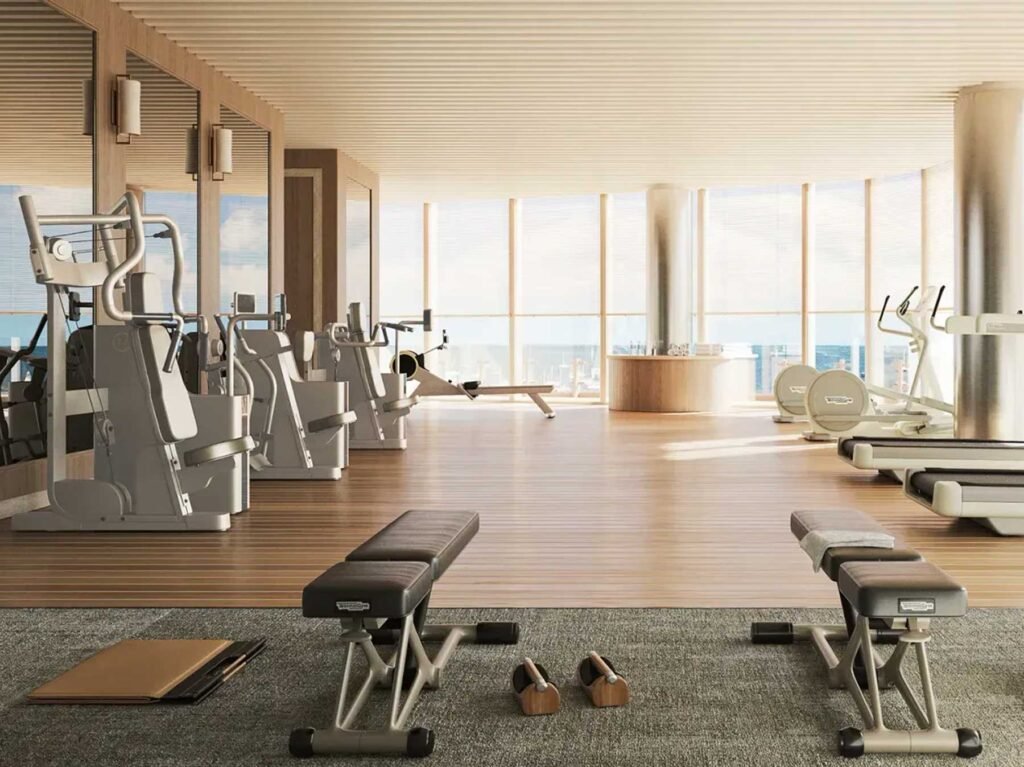
- Four pools, restaurants, private club, gym, gardens and a park
- A club built in the Depression, for people it did not affect
- Why designation is the real asset
- Four products on one campus — know which you are buying
- Surfside, and the elephant in the room
- How is The Surf Club Four Seasons being financed?
- The honest summary
- Three corrections to the record above
- The county’s record condo sale — at the Seaway
A club built in the Depression, for people it did not affect
Firestone and Pancoast
Harvey Firestone built The Surf Club during the Great Depression — a fact worth sitting with, because it explains the ambition. Russell Pancoast, whom the Miami Design Preservation League calls a “pioneering Miami architect,” delivered what MDPL describes as “the highly ornate, and authentically detailed Mediterranean style that was in vogue.”
The surviving fabric is exceptional: high beamed and vaulted ceilings, majestic colonnades, massive fireplaces, original murals, original light fixtures and doors, and the distinctive horseshoe-shaped row of wooden cabanas that remains the club’s signature.
Who came
The membership and guest list reads like a century of celebrity: the Shah of Iran, Winston Churchill, Noël Coward, Douglas Fairbanks Jr., Elizabeth Taylor, the Duke and Duchess of Windsor, Frank Sinatra, Tennessee Williams, Joan Crawford and Liberace.
The events were of a piece with the guest list — poolside fashion shows directed by Elizabeth Arden, black tie boxing dinners, and galas that at various points featured elephants and, on one occasion, 300 tables made of ice. It served alcohol through Prohibition.
This matters commercially and not just romantically: provenance of this depth cannot be manufactured. What buyers have actually paid is in the sale record further down this page.
Why designation is the real asset
MDPL is precise: the building is “legally protected as a designated historic structure by Miami-Dade County.”
What that guarantees
Every other trophy oceanfront parcel in Miami-Dade carries the same latent risk — that the thing which makes it special is one entitlement fight away from being replaced by something taller. Designation removes that. The 1930 clubhouse, the colonnades, the murals and the horseshoe of cabanas are not a design choice the current owner has made; they are an obligation the owner has inherited.
For a buyer that converts a charming amenity into a durable one. You are not relying on a developer’s taste or an operator’s continuity. You are relying on a county designation, which outlasts both.
What it costs
Protection cuts the other way too, and the page would be dishonest not to say so. Restoring and maintaining designated fabric — original murals, original doors, ninety-year-old timber cabanas in salt air — is materially more expensive than maintaining new construction, and the work must satisfy preservation review rather than simply a contractor. Ask how those costs are allocated between the hotel operation and the residential associations, because that allocation is a negotiated arrangement rather than a natural law.
Four products on one campus — know which you are buying
The 2016–17 redevelopment produced three twelve-story towers containing three legally distinct things, and buyers routinely conflate them. A fourth arrived in 2024, next door and under its own declaration.
The 121 private residences
Conventional condominium ownership, governed by a declaration and an association. This is the product most buyers mean when they say they want to buy at The Surf Club.
The 30 hotel residences
Residences attached to the hotel operation. As with any condo-hotel, the essential documents are the rental management agreement and the declaration — who may occupy, for how long, what the revenue split is, who bears the cost of bringing a unit to brand standard, and what happens if the operator changes. The W South Beach closure and rebrand a few miles south is a live demonstration of why those questions matter.
The hotel and club
Seventy-seven guest rooms, restaurants, the private club, four pools, gym, gardens and park. Residents’ access to these is defined by agreement, not by proximity. Establish exactly what your unit is entitled to, whether club membership is mandatory, optional or transferable, what it costs, and whether the entitlement runs with the deed.
The Seaway — the fourth product, and a separate declaration
North of the Four Seasons towers, at 9149 Collins Avenue, stands The Seaway at The Surf Club, completed in 2024 and developed, like the rest of the campus, by Fort Partners. It is not part of the 150 folios (148 homes and two hotel-class folios) described above. The county records it as its own condominium — SC 2 Residences Condo — and a pull of the Miami-Dade County Property Appraiser roll on 22 September 2026 returns 41 folios whose undivided interests sum to exactly 100 percent: one common-area folio, four commercial units, and 36 residences. That count matches the developer’s own, reported by The Real Deal on 24 November 2025.
The practical point for a buyer is not the address. A Seaway residence is governed by a different declaration, a different association and a different budget from a Four Seasons residence a few hundred feet south. Reserves, assessments, rental rules and club entitlement all have to be read against that document. Sharing a lawn with the Four Seasons does not make you party to its paperwork.
Surfside, and the elephant in the room
The Surf Club sits in the Town of Surfside — the same municipality as Champlain Towers South. Any honest page about buying here has to address that rather than route around it.
What it means, and what it does not
Surfside’s building department and inspection culture came under intense scrutiny after June 2021, and the state’s response — the milestone inspection regime under Florida Statute 553.899 and the Structural Integrity Reserve Study requirement — was written in direct response. A buyer here is purchasing into a closely examined regulatory environment, which is a feature rather than a defect.
On the specific question of subsidence: University of Miami research measured 35 barrier-island buildings settling 2 to 8 centimeters between 2016 and 2023, with a lesser cluster in Surfside. The researchers declared no building unsafe, and critically found no displacement at all at Champlain Towers South before its collapse — meaning settlement was not the cause. Our full analysis is in our breakdown of the University of Miami measurements.
The milestone position
Under FS 553.899, buildings within three miles of the coastline require a milestone inspection at 25 years, then every 10. The residential towers completed in 2017, placing their first milestone around 2042 — subject to the certificate of occupancy date, which legally controls. The historic clubhouse is a separate structure with its own obligations; ask how they are funded.
- Confirm which product you are buying — private residence, hotel residence, or something with a club interest attached. They are not interchangeable.
- The shared-facilities and club agreements — what your unit is entitled to, whether it runs with the deed, what it costs, and what happens on a change of operator.
- How historic-fabric maintenance is allocated. Preservation-grade restoration is expensive and recurring. Establish the split between hotel and residential associations, and whether it can be reset.
- The certificate of occupancy date for your tower, and the Structural Integrity Reserve Study alongside the budget.
- The master insurance policy and per-unit deductible — above $50,000 it breaks Fannie Mae eligibility outright.
- Owner-occupancy percentage, delinquency rate and rental rules — all Full Review inputs on a campus with a hotel component.
- Twenty-four months of board minutes.
How is The Surf Club Four Seasons being financed?
Since 3 August 2026, Fannie Mae’s Lender Letter LL-2026-03 has retired the Limited Review path for established condominium projects over ten units, so Full Review applies at every down-payment level. From 4 January 2027, minimum reserves rise from 10% to 15% of annual budgeted assessment income.
In June 2026, Miami-Dade condominiums ran 11,550 active listings, 12.3 months of supply and a median down 3.1% to $431,000, with 48.5% of sales closing in cash. Mixed-use campuses with hotel components attract more lender scrutiny than plain condominiums, not less — get your lender’s view on the project before your deposit goes hard.
Three corrections to the record above, from the declaration itself
The sales table above is drawn from the county’s own file and stands. Re-checking the underlying declaration on 24 August 2026 turned up three things it is worth being precise about, because two of them change the numbers and the third is a governance fact a buyer should know before making an offer.
One. This is a single condominium, not two. All 148 residential folios carry the same folio prefix, the same subdivision name — Surf Club Condo — and the same recording reference, Official Records 29040-3186. 9001 and 9111 Collins Avenue are two street addresses on one declaration, not two declarations side by side. That matters practically: there is one set of common elements, one undivided-interest schedule and one association governing both addresses.
Two. There are 148 homes, not 147. One folio was absent from the earlier pull: 14-2235-047-1230, unit N-1015, 3,025 square feet, carrying an undivided 0.4486% interest. It is a real, separately assessed residence. I found it by testing the declaration’s undivided shares — every unit owns a stated percentage of the common elements and by law they sum to 100% — and chasing the shortfall through the folio series until the missing home turned up. Ten other apparent gaps in that series proved to be retired folios, merged into neighboring units and correctly excluded.
Three, and this is the one to act on. A single commercial hotel unit holds 27.2797% of this condominium’s common elements. Folio 14-2235-047-1580, described in the legal as UNIT S/C UNIT and coded by the county as hotel condominium commercial, covers 184,417 square feet. The 148 residential homes hold 70.8741% between them.
Put plainly: more than a quarter of the undivided interest in this building belongs to one commercial owner, not to the residences. That is not a defect and it is not unusual for a hotel-and-residences campus — it is how these buildings are structured. But undivided interest is the currency of a condominium: it is generally the basis on which common expenses are apportioned and, depending on the documents, how votes are weighted. Before you buy here, read how the declaration allocates shared costs and voting between the residential units and the hotel unit, and ask the association what proportion of the annual budget the hotel lot actually carries.
I raise it here rather than as a warning because the question is entirely answerable from documents you are entitled to see, and because at other Miami condo-hotels the same structure has become the subject of litigation between the residential association and the hotel owner. Asking early costs nothing.
The honest summary
There is no second Surf Club. Nine acres of Surfside oceanfront, a 1930 Pancoast clubhouse that the county will not let anyone demolish, a guest list running from Churchill to Sinatra, and a Four Seasons operating the whole thing. The provenance is real and the protection that preserves it is legal rather than sentimental.
What you must do is establish which of the four products you are buying, what your entitlements actually are in writing, and how the cost of maintaining ninety-year-old protected fabric is shared. Those are answerable questions, and the answers are what separate a good purchase here from an expensive assumption.
See also Surfside next door, the Village of Bal Harbour, Eighty Seven Park further north and luxury towers elsewhere in Miami.
Related reading: Oceana one village north · Eighty Seven Park on the North Beach line · the mid-market price band.
What has actually traded here since January 2025
I pulled every folio the Miami-Dade County Property Appraiser holds at the two Four Seasons addresses — 9111 Collins Avenue and 9001 Collins Avenue, which share one declaration. Across them, 148 homes (the county roll’s count; the developer’s 121 private and 30 hotel residences add to 151) and 22 qualified, arm’s-length sales since 1 January 2025, of which the table shows the eight highest-priced. The Seaway at 9149 Collins is a third declaration on this campus and is counted separately, in the section below.
| Date | Price | Size | $/sq ft | Address |
|---|---|---|---|---|
| 10 March 2026 | $44,000,000 | 4,924 sq ft | $8,936 | 9111 Collins |
| 23 July 2025 | $38,200,000 | 5,675 sq ft | $6,731 | 9001 Collins |
| 15 January 2026 | $33,000,000 | 7,387 sq ft | $4,467 | 9001 Collins |
| 14 August 2026 | $30,250,000 | 4,235 sq ft | $7,143 | 9001 Collins |
| 26 May 2026 | $27,319,500 | 5,321 sq ft | $5,134 | 9111 Collins |
| 19 August 2026 | $25,600,000 | 3,992 sq ft | $6,413 | 9111 Collins |
| 18 March 2025 | $24,886,000 | 5,321 sq ft | $4,677 | 9111 Collins |
| 16 April 2026 | $20,500,000 | 3,948 sq ft | $5,193 | 9001 Collins |
The campus record by rate is $8,936 per square foot, set on 10 March 2026 at 9111 Collins. Note how little the rate per foot tracks the headline price: the $33,000,000 sale in January 2026 is the third-largest number in the table and one of the lowest rates in it, because it is the largest home. At this level, price tells you what someone bought; rate per foot tells you what they paid.
The county’s record condo sale happened here — at the Seaway, not the Four Seasons
The most expensive condominium sale Miami-Dade has on record did not happen in either tower above. County folio 14-2235-051-0360 — SC 2 Residences Condo, unit PH-11, 16,053 sq ft, built 2024 — carries a qualified sale dated 10 November 2025 at $86,004,500, which is $5,358 per square foot. The Real Deal reported the closing on 24 November 2025 as the highest price ever paid for a condominium in Miami-Dade County, ahead of the $60,000,000 Faena House penthouse of 2015; its square footage and rate match the county roll exactly.
One thing to read carefully on that folio. The 2026 assessed value is $62,244,000 against $6,343,964 for 2025. That is the roll catching up with a newly completed, newly sold unit — not a change in what the home is worth. Assessed value on a 2024-delivered building lags the market by a full cycle, and on a new-construction purchase it is the least useful number on the page.
What the whole building has done
I pulled all 41 folios at 9149 Collins on 22 September 2026. The undivided interests sum to exactly 100 percent, so this is the complete declaration, not a partial pull. Of the 36 residences, 33 have recorded a qualified sale — the first on 20 September 2024, the most recent on 18 May 2026 — for $585,754,800 in total, at a median of $14,870,000 and a median $3,540 per square foot. Three residences (102, 201 and 604) have never recorded one.
| Date | Price | Unit | Size | $/sq ft |
|---|---|---|---|---|
| 10 November 2025 | $86,004,500 | PH-11 | 16,053 sq ft | $5,358 |
| 5 December 2025 | $54,878,700 | PH-10A | 12,716 sq ft | $4,316 |
| 8 January 2026 | $54,000,000 | 101 | 12,174 sq ft | $4,436 |
| 6 November 2024 | $30,357,200 | 701 | 8,393 sq ft | $3,617 |
| 18 May 2026 | $27,100,000 | 301 | 4,519 sq ft | $5,997 |
| 15 July 2025 | $24,500,000 | 103 | 4,431 sq ft | $5,529 |
| 20 September 2024 | $24,464,500 | 702 | 7,018 sq ft | $3,486 |
| 24 September 2024 | $23,580,000 | 901 | 7,435 sq ft | $3,171 |
Two cautions before anyone uses those medians. First, the building sold out from the developer in a single run — 23 of the 33 sales closed in 2024, most of them within six weeks — so this is largely a first-sale record, not a resale market, and it tells you what Fort Partners achieved rather than what the units would fetch again today. Second, eight of the 36 residences measure between 290 and 467 sq ft, then the roll jumps straight to 1,076 sq ft. Those eight traded between $770,000 and $1,530,000 and they pull the building median down. Strip them out and the 25 remaining sales run to a median of $18,292,300 at $3,617 per square foot. The declaration does not say what those eight small units are, so I am not going to guess on your behalf — but if you are pricing a Seaway residence off a published median, know which set of numbers you are looking at.
Against the Four Seasons towers next door, the shape is different in the way you would expect of a 2024 building that sold out at once: a higher median price, a lower median rate per foot, and a campus rate record that still belongs to 9111 Collins at $8,936 per square foot.
The unit that traded twice: a worked example
On 20 August 2026 The Real Deal reported that unit S-1003 at 9001 Collins had changed hands for about $30 million, describing it as a 65% gain. That is a useful headline. Here is the deed history underneath it, from the county record.
The folio is 14-2235-047-0220 — Surf Club Condo, unit S-1003, 4,235 square feet, four bedrooms, an undivided 0.6281% interest in the common elements. The county carries three qualified sales on it:
| Date | Price | $/sq ft | Change |
|---|---|---|---|
| 30 January 2020 | $12,100,000 | $2,857 | — |
| 21 July 2025 | $18,350,000 | $4,333 | +51.7% over 5.5 years |
| 14 August 2026 | $30,250,000 | $7,143 | +64.9% over about 13 months |
The 2026 sale is now on the county roll. It recorded at $30,250,000 on 14 August 2026, which is +64.9% on the $18,350,000 paid on 21 July 2025, at about 13 months apart and $7,143 per square foot. That rate is below the campus record of $8,936 set five months earlier. The reported “about $30 million” and “65%” match the county figure.
The 2026 assessed value on this folio is $14,329,757. Assessed value is not market value and should never be read as one, but the gap between it and the sale figures is itself worth understanding before you make an offer in this building.
This is the part I would want if I were buying here: not the headline, but the two dates, the two prices, the size that converts them into a rate, and a clear statement of which number is verified and which is not.
The Surf Club — common questions
What have homes at The Surf Club Four Seasons sold for in the last 12 months?
12 sales were recorded on the Miami-Dade County Property Appraiser record in the 12 months to 23 September 2026, at a median of $19,123,550 ($5,046 per square foot). The latest recorded sale was on 19 August 2026. These are recorded closings, not asking prices. If you own at The Surf Club Four Seasons and want to know what your home would sell for, message Josh Stein on WhatsApp at (305) 695-8257.
What have homes at The Surf Club sold for in the last 12 months?
12 sales were recorded on the Miami-Dade County Property Appraiser record in the 12 months to 23 September 2026, at a median of $19,123,550 ($5,046 per square foot). The latest recorded sale was on 19 August 2026. These are recorded closings, not asking prices. If you own at The Surf Club and want to know what your home would sell for, message Josh Stein on WhatsApp at (305) 695-8257.
When was The Surf Club built?
It opened on New Year’s Eve 1930, built by tire magnate Harvey Firestone during the Great Depression and designed by the pioneering Miami architect Russell Pancoast on nine acres of Surfside oceanfront. The Miami Design Preservation League describes it as exemplifying “the highly ornate, and authentically detailed Mediterranean style that was in vogue.”
Is The Surf Club a protected historic building?
Yes. The original building is “legally protected as a designated historic structure by Miami-Dade County.” That is a defining fact about the address: the 1930 clubhouse, colonnades, original murals and the horseshoe row of wooden cabanas cannot simply be replaced by a future owner. It converts a charming amenity into a durable one — though maintaining protected fabric in salt air is materially more expensive than maintaining new construction.
Who stayed at The Surf Club?
The membership and guest list included the Shah of Iran, Winston Churchill, Noël Coward, Douglas Fairbanks Jr., Elizabeth Taylor, the Duke and Duchess of Windsor, Frank Sinatra, Tennessee Williams, Joan Crawford and Liberace. Events included poolside fashion shows directed by Elizabeth Arden, black tie boxing dinners, and galas featuring elephants and, on one occasion, 300 tables made of ice. It served alcohol throughout Prohibition.
What is at The Surf Club today?
Three twelve-story towers containing 121 private residences, 30 hotel residences and a 77-room Four Seasons, alongside restaurants, a private club, four pools, a gym, gardens and a park. The restoration and new construction were designed by Kobi Karp, with interiors by Joseph Dirand, for owner Nadim Ashi of Fort Partners. It reopened in 2017.
What is the difference between a private residence and a hotel residence here?
A private residence is conventional condominium ownership governed by a declaration and an association. A hotel residence is attached to the hotel operation, so the rental management agreement and declaration govern who may occupy it and for how long, the revenue split, who bears the cost of meeting brand standards, and what happens if the operator changes. They are not interchangeable, and a buyer should confirm in writing which one they are purchasing.
Does the Surfside collapse affect buying here?
The Surf Club is in the Town of Surfside, the same municipality as Champlain Towers South. The state’s response to that collapse — the milestone inspection regime under Florida Statute 553.899 and the Structural Integrity Reserve Study requirement — means a buyer here purchases into a closely examined regulatory environment, which is a feature rather than a defect. On subsidence specifically, University of Miami researchers found no displacement at all at Champlain Towers South before its collapse, meaning settlement was not the cause.
Sources and further reading
- Miami Design Preservation League — The Surf Clubmdpl.org
- Four Seasons Press — The Surf Club, Yesterday and Todaypress.fourseasons.com
- University of Miami Rosenstiel School — subsidence hotspots in South Floridanews.miami.edu
- Florida Statute 553.899 — Mandatory structural inspectionsflsenate.gov
- Fannie Mae — Lender Letter LL-2026-03singlefamily.fanniemae.com
- MIAMI REALTORS — South Florida Market Stats, June 2026miamirealtors.com
- The Real Deal — Mystery seller flips Four Seasons Surf Club condo for $30M, 20 August 2026therealdeal.com
- Miami-Dade County Property Appraiser — Property Search (69 folio records for 9111 COLLINS AVE and 81 for 9001 COLLINS AVE, including folio 14-2235-047-0220, retrieved 24 August 2026)miamidadepa.gov
Thinking about The Surf Club Four Seasons?
I have sold South Florida property since 2002, more than $1 billion of it. Ask me for the recorded declaration, what has genuinely closed, or a straight answer on whether this building fits what you are after.
Josh Stein · Florida real estate sales associate, license SL3057661 · (305) 695-8257 · hello@joshsteinrealtor.comGet this building’s next recorded sale — before the listing sites catch up
- Every closed sale we can verify from the Miami-Dade record — price, date, and $/sqft when the deed supports it — not an IDX feed.
- Optional alert when a new deed posts in this building (or a short list of comps you choose).
- No spam inventory blasts. One building. One record. You decide what happens next.
Tell Josh which building. He’ll send the latest closed sales and set a quiet alert.
Get the sales recordRelated coverage
Part of Miami Luxury Condos.