

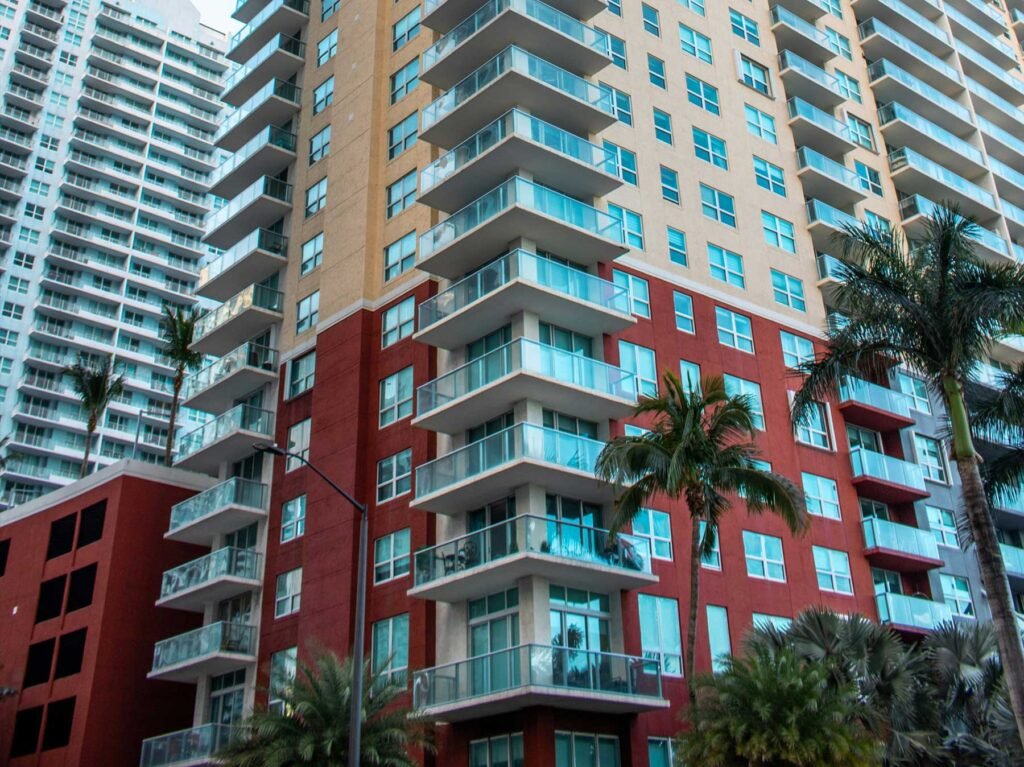
Building facts
- Address
- 1050 & 1060 Brickell Avenue
- Neighborhood
- Brickell
- Year built
- 2008
- Floors
- 34
- Residences
- 576
- Status
- Completed
- Developer
- Extell Management and Investment Company
- Architect
- SB Architects
- Pricing
- Starting at $379,000
1060 Brickell is a two-tower, 45-storey complex of 592 units completed in 2008 at the centre of Brickell Avenue. Over the past two years it has also been the most instructive condominium governance story in Miami — a $21 million special assessment, a contested board, a certified owner recall, and a circuit court order replacing the board. Anyone considering a unit here needs the whole sequence, not the brochure.
- 1060 Brickell Avenue, Miami — two towers, 45 storeys
- 592 units, of which 16 are commercial
- Completed 2008
- $21 million special assessment approved 13 November 2024
- Average cost per unit $35,000+, some exceeding $40,000, with 25% payable upfront
- Board replaced by court order, late September 2025
What the assessment pays for
The $21 million was allocated across four principal items:
- $7.7 million — façade restoration of Tower II
- $3.5 million — parking garage and basement repairs
- $2.5 million — general conditions
- $1.7 million — rotunda repairs and restoration
Why these are structural, not cosmetic
Those are structural and envelope items, not cosmetic ones. Façade and garage work on a bayfront-adjacent concrete tower is exactly the category of expenditure that Florida’s post-Surfside regime was designed to force into the open, and it is expensive by nature.
The dispute, with both sides stated
The owners case
Owners objected on process rather than on whether the building needed work. The reported complaints were that the assessment was approved without a proper unit-owner vote, that the description and notice were inadequate, that the timeline ran through the holidays, and that a 16-year-old building should not require repairs of this magnitude. One owner told CBS Miami the process left them “absolutely left in the dark. It was rammed through.” Another said simply, “I feel like I’m being milked.”
The board’s position was that Florida law leaves it no discretion. Association general counsel Marc Halpern stated that “the board is charged with the responsibility to adequately maintain and repair the common elements,” and, addressing the objection that the Structural Integrity Reserve Study had not used the word “critical,” that “while the reports did not use the term critical, it is the Board’s responsibility to address issues before they become critical.” Then-board president Jacob Kassel put it more bluntly: “We’re not going to allow another Champlain Towers collapse to happen in a building I live in or that I’m responsible for.”
Why both positions are defensible
Both positions are defensible, and that is what makes this case useful rather than merely dramatic. A board that under-maintains a tower is the Surfside failure mode. A board that assesses $21 million without the process the statute requires is a different failure mode. Florida condominium law is currently generating both.
How it resolved
The recall
Owners pursued a statutory recall. James Duddey submitted 304 recall ballots against a state threshold of 289; an arbitrator found 296 valid, and the Florida Department of Business and Professional Regulation issued a final order certifying the recall and requiring the board to stand down and transfer records.
When that was contested, the matter reached the Miami-Dade Circuit Court. In late September 2025, Judge Joseph Perkins ordered that the incumbent board be replaced and that it turn over all records and property. A new board took office: Dorinda Spahr as president, with Jermaine Jones and Javier Noriega.
Spahr’s summary of the process is worth quoting, because it is the real cost: “Our outcome followed nearly a year of intense and costly legal battles against a board that refused to step down.”
The class action still open
A separate class action brought by Jessica Bergman and Antonio Sevillano, filed in December 2024, challenges whether the special assessment itself complied with Florida law. That question — the validity of the $21 million — was not resolved by the governance ruling, and its status should be confirmed directly with the association.
What a buyer should take from this
The instinct is to read all this as a reason to avoid the building. That is usually the wrong conclusion, for three reasons.
First, the work is being done. A tower that has assessed for and executed façade, garage and rotunda restoration is, on the other side of that spend, in better condition than a comparable building that has deferred it. The buildings to worry about are the ones with no assessment and no SIRS-funded plan — because their bill has not arrived yet.
Second, the governance dispute has been adjudicated. A recall certified by the state and confirmed by a circuit judge, with a new board in place, is a resolved condition rather than an open one. That is materially different from a building where the same conflict is still running.
This is exactly what Full Review looks for
Third, and most usefully: this is exactly what Fannie Mae’s Full Review now looks for. Since 3 August 2026, Lender Letter LL-2026-03 has retired the Limited Review path for established projects over ten units, so every lender on every unit in this building now reads the milestone report, the reserve study, the budget and the insurance. Litigation and unresolved structural findings are precisely the items that can render a project ineligible — which makes a building effectively cash-only. With 48.5% of Miami-Dade condo sales closing in cash in June 2026, losing eligibility removes roughly half the buyer pool, in a market already carrying 12.3 months of supply.
So the question is not “was there a fight.” It is: is the assessment funded and substantially complete, is the litigation resolved or disclosed, and will this project clear Full Review today?
- What is the current status of the $21 million assessment on this unit? Paid in full by the seller, partially paid, or outstanding? Get it in writing from the association, not from the listing. Who pays the balance is a contract term — negotiate it explicitly.
- Is the Bergman/Sevillano class action resolved? If the assessment is later found invalid, what happens to money already collected — and if it is upheld, is there more to come?
- Is the façade, garage and rotunda work complete? Percentage complete, contractor, and whether the budget has held. Cost overruns on façade work are the norm, not the exception.
- Get the current Structural Integrity Reserve Study and the budget together. The SIRS identifies the need; the budget shows whether it is funded. The gap between them is the next assessment.
- Request the estoppel letter early and read it against the association’s own numbers.
- Ask your lender to confirm the project’s review status before you go hard. This is a pending-litigation building; that is a Full Review question and you want the answer before the deposit is at risk.
- Read 24 months of minutes. In this building in particular, the minutes are the document that matters most.
The milestone timeline
Under Florida Statute 553.899, buildings three storeys or taller require a milestone structural inspection at 30 years — 25 years within three miles of the coastline — and every 10 years after. On a 2008 completion, 1060 Brickell’s first milestone falls in the early 2030s, subject to the certificate of occupancy date, which is the figure that legally controls.
Read alongside the assessment, that is arguably the most reassuring fact available: the façade and garage work has been brought forward and paid for ahead of the milestone cycle rather than being discovered inside it. Buildings that meet their milestone with the work already done are in a far better position than buildings that meet it with everything deferred.
The honest summary
1060 Brickell is a large, well-located 2008 tower that went through a genuinely difficult two years: a $21 million assessment averaging over $35,000 a unit, a contested board, a state-certified recall and a court-ordered replacement. Owners paid for it in money and in legal fees.
What sits on the other side of that is a building whose structural work has been funded and largely executed, with a resolved governance position, roughly seven years before its first milestone inspection. Priced correctly — and with the assessment balance and litigation status confirmed in writing — that is a defensible purchase. Priced as though none of it happened, it is not.
See also Brickell, the Miami’s luxury condominium inventory market and The Miami Confidential.
Related reading: Ten Museum Park and its 2032 milestone · Paramount, a comparable downtown tower · the Edgewater bayfront.
1060 Brickell — common questions
What is the 1060 Brickell special assessment?
A $21 million special assessment approved by the board on 13 November 2024, allocated as $7.7 million for Tower II façade restoration, $3.5 million for parking garage and basement repairs, $2.5 million for general conditions and $1.7 million for rotunda repairs. The average cost was reported at more than $35,000 per unit, with some exceeding $40,000, and 25% payable upfront. Confirm the current status on any specific unit in writing with the association.
Why did 1060 Brickell owners object?
The objections were about process rather than about whether work was needed. Owners argued the assessment was approved without a proper unit-owner vote, with inadequate description and notice, on a timeline running through the holidays, and for a building then only about 16 years old. The board’s counsel Marc Halpern responded that “the board is charged with the responsibility to adequately maintain and repair the common elements,” and that even though the reserve study had not used the word “critical,” it was the board’s job “to address issues before they become critical.”
Was the 1060 Brickell board removed?
Yes. Owners pursued a statutory recall — 304 ballots submitted against a threshold of 289, with an arbitrator finding 296 valid — and the Florida DBPR certified it. When that was contested, Miami-Dade Circuit Judge Joseph Perkins ordered in late September 2025 that the incumbent board be replaced and hand over all records. Dorinda Spahr became president, with Jermaine Jones and Javier Noriega.
Is the litigation over the assessment finished?
The governance ruling did not decide it. A separate class action filed in December 2024 by Jessica Bergman and Antonio Sevillano challenges whether the special assessment complied with Florida law. Its status should be confirmed directly with the association before making an offer, because pending litigation is a Fannie Mae Full Review item and can affect a project’s financing eligibility.
Should I avoid buying at 1060 Brickell?
Not automatically. A building that has assessed for and executed façade, garage and rotunda restoration is in better physical condition afterwards than a comparable tower that deferred the same work — the buildings to worry about are those whose bill has not arrived yet. The governance dispute has been adjudicated. The questions that matter are whether the assessment on your specific unit is paid, whether the work is complete and on budget, whether the class action is resolved, and whether the project clears Fannie Mae Full Review today.
When is 1060 Brickell’s milestone inspection due?
Florida Statute 553.899 requires a milestone inspection at 25 years for buildings within three miles of the coastline, then every 10 years. On a 2008 completion that places the first milestone in the early 2030s, subject to the certificate of occupancy date, which legally controls. Notably, the façade and garage work has been brought forward and funded ahead of that cycle rather than being discovered within it.
Sources and further reading
- The Real Deal — Turmoil at Brickell condos over association board, feestherealdeal.com
- The Real Deal — 1060 Brickell unit owners notch court win against associationtherealdeal.com
- CBS Miami — $21 million special assessment sparks controversy among Brickell condo ownerscbsnews.com
- Florida Statute 553.899 — Mandatory structural inspectionsflsenate.gov
- Fannie Mae — Lender Letter LL-2026-03singlefamily.fanniemae.com
- MIAMI REALTORS — South Florida Market Stats, June 2026miamirealtors.com
Related coverage
Part of Miami Luxury Condos.