
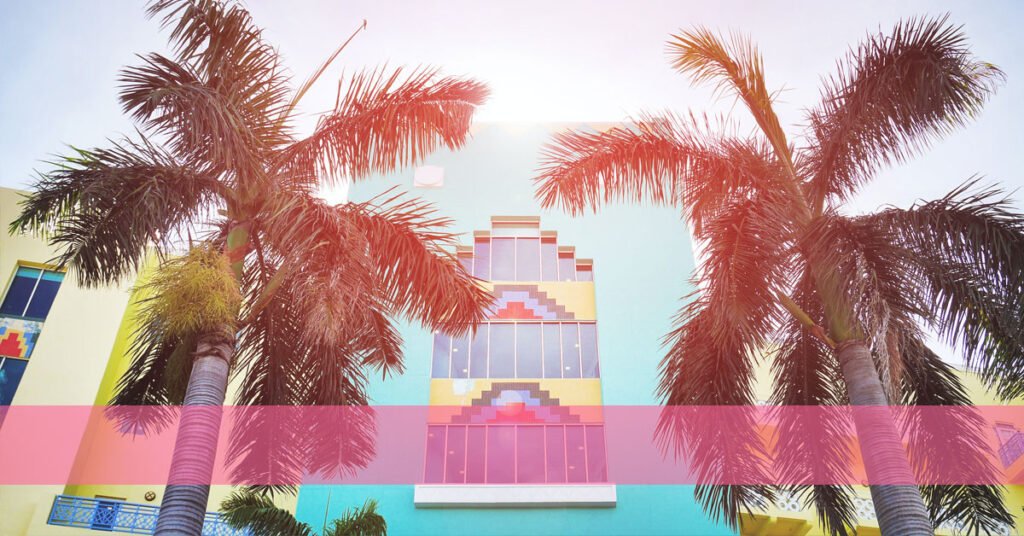
Miami Beach holds the largest collection of Art Deco architecture in the world. The Miami Beach Architectural District — listed on the National Register on 14 May 1979 — protects somewhere between roughly 800 and 960 historic buildings depending on how you count, most built between the mid-1920s and the early 1940s. What almost nobody explains to buyers is which of those buildings you can actually own, and why the answer is so limited.
The Boundary That Explains South Beach Pricing
The district runs from the Atlantic Ocean west to Alton Road, and from the Collins Canal and Dade Boulevard in the north down to 6th Street in the south. That southern edge is the single most important line on the map. South of Fifth sits outside the district, which is why it holds 40-storey glass towers like Continuum and Apogee, while the blocks immediately north are two- and three-storey pastel buildings that can never be replaced by towers.
Once you see that line, the South Beach price map stops being confusing. Protected low-rise stock north of 6th Street and unprotected high-rise land south of Fifth are two entirely different products in walking distance of each other.
What You Can Actually Own
Most of the famous Art Deco buildings on Ocean Drive are hotels, not condominiums — you can admire them, stay in them, and photograph them, but you cannot buy a residence in them. The genuinely ownable Art Deco stock sits mostly a few blocks inland, on Pennsylvania, Meridian, Michigan, Euclid and Jefferson Avenues and around Española Way.
These are small buildings. The Royal South Beach at 763 Pennsylvania Avenue, built in 1936, has just 42 residences — and that is on the larger end. Buildings around Española Way, Lincoln Road, Meridian and Euclid trade broadly in the $170,000 to $380,000 range, which makes Art Deco ownership the most accessible entry point into historic South Beach by a wide margin. Verify current pricing and each building’s year built against county records before making an offer; published inventories for this segment are inconsistent.
What Preservation Means for an Owner
Buying inside a historic district changes what you can do with the property. Exterior alterations — windows, façade colour, signage, additions — generally require review, and original building elements are protected in ways that do not apply elsewhere in Miami. That is the trade: you accept constraints on the outside in exchange for the guarantee that the character of the street around you cannot be demolished and rebuilt at 40 storeys.
The practical consequences are worth planning for. Renovations take longer and cost more than in a modern building. Windows and impact glazing are the usual friction point. And because these buildings are eighty to a hundred years old, Florida’s milestone inspection and structural reserve requirements are directly relevant — review the inspection report, the reserve study and the assessment history before you commit.
Who Built It, and Why It Survived
The district’s signature architects were Albert Anis, L. Murray Dixon and Henry Hohauser, working across Art Deco, Streamline Moderne, Mediterranean Revival and International styles. It survived because of the Miami Design Preservation League, incorporated on 6 May 1977 and driven by Barbara Capitman, whose campaign stopped the demolition wave. Miami Vice, which premiered on 16 September 1984, then turned the district into a global image. In 2025 Art Deco marked its centennial, a hundred years after its debut at the 1925 Paris exposition.
Key Takeaways
- The world’s largest Art Deco collection — roughly 800 to 960 protected buildings, National Register-listed since 1979.
- The district ends at 6th Street, which is precisely why South of Fifth has towers and the blocks north of it do not.
- Most Ocean Drive landmarks are hotels; ownable Art Deco condos sit inland around Española Way, Pennsylvania, Meridian and Euclid.
- Entry pricing runs broadly $170,000 to $380,000 — the most accessible way into historic South Beach.
- Expect exterior-alteration review, slower renovations, and serious diligence on inspections and reserves in eighty-year-old buildings.
Frequently Asked Questions
Can you buy an apartment in an Art Deco building in Miami Beach?
Yes, but not usually on Ocean Drive — most of those landmarks are hotels. The ownable Art Deco condominiums are mainly inland, around Española Way, Pennsylvania Avenue, Meridian Avenue and Euclid Avenue.
How much do Art Deco condos cost in Miami Beach?
Broadly $170,000 to $380,000 across the small historic buildings, making it the most accessible entry into historic South Beach. Confirm current pricing building by building.
How big is the Miami Beach Art Deco District?
It runs from the Atlantic to Alton Road and from the Collins Canal and Dade Boulevard south to 6th Street, protecting roughly 800 to 960 historic buildings — the largest collection of Art Deco architecture in the world.
Why are there tall towers in South Beach if it is a historic district?
Because the district stops at 6th Street. South of Fifth falls outside the protected area, which is why 40-storey buildings like Continuum and Apogee exist there while the blocks just north remain two and three storeys.
Can I renovate an Art Deco condo?
Interiors are generally more flexible than exteriors. Changes to façades, windows, colour and signage typically require historic review, so budget more time and cost than for a modern building.
Are old Art Deco buildings risky to buy after Surfside?
They require real diligence. These buildings are eighty to a hundred years old and fall squarely under Florida’s milestone inspection and structural reserve rules, so review the inspection report, reserve study and assessment history before offering.
Who designed the Art Deco District?
Principally Albert Anis, L. Murray Dixon and Henry Hohauser, across Art Deco, Streamline Moderne, Mediterranean Revival and International styles.
How was the Art Deco District saved?
By the Miami Design Preservation League, incorporated in May 1977 and led by Barbara Capitman, which halted demolition. Miami Vice, from 1984, then made the district internationally famous.
Explore further: South Beach · Miami luxury condos · Miami lofts · the full Art Deco guide · selling your Art Deco condo