

Verified 23 July 2026Miami-Dade County Property Appraiser, Florida YIMBY, The Real Deal +6 more9 sources
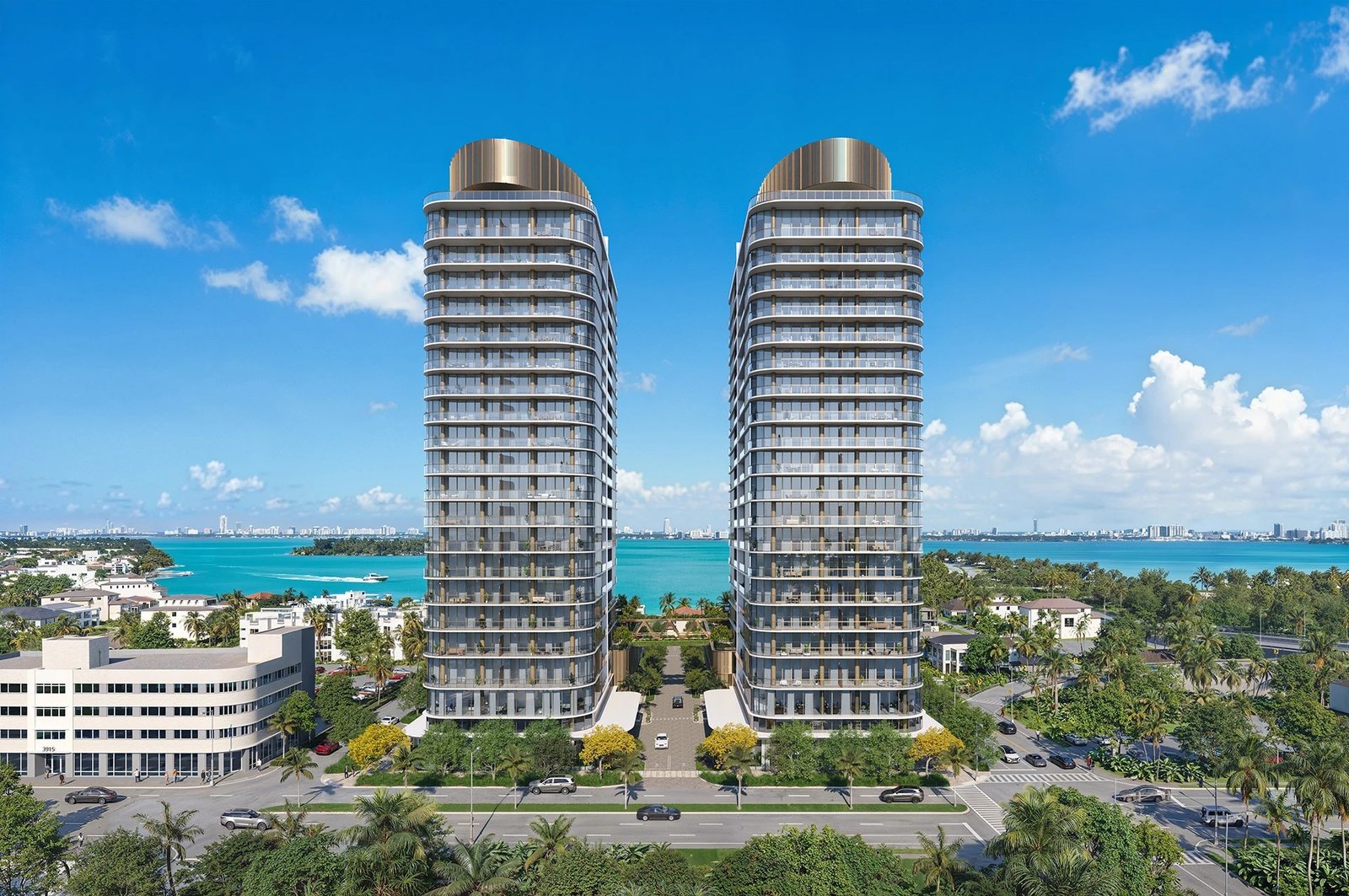
The two towers from the east, over Biscayne Bay. Developer rendering.
The block from the air, at the north end of the Design District.
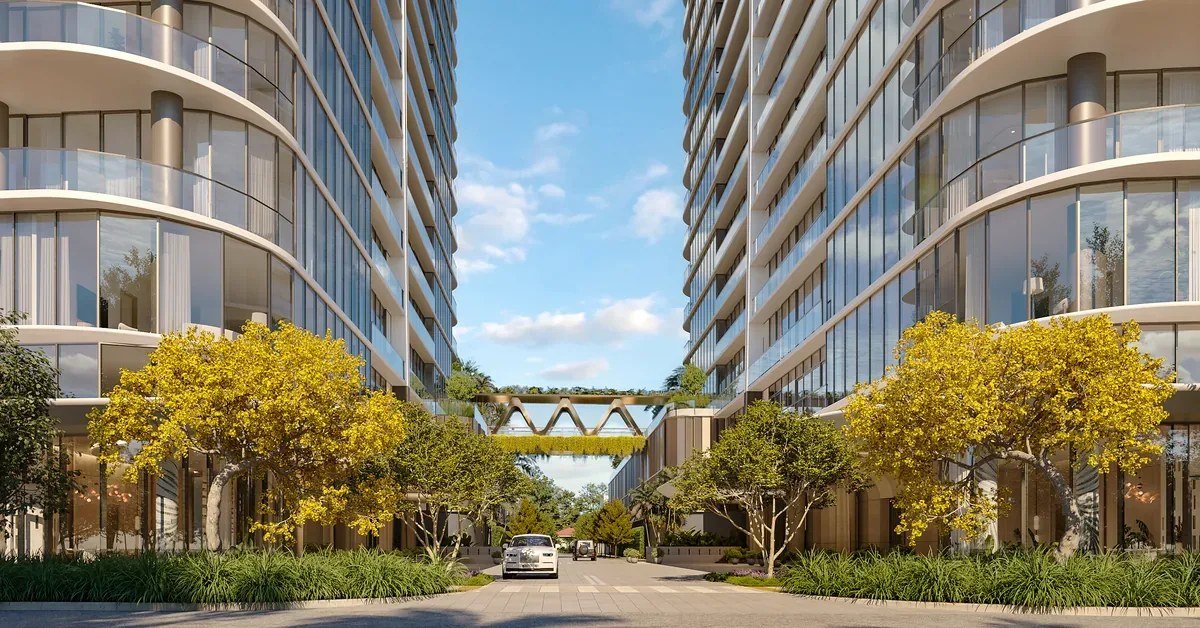
The private drive that runs between the two towers.
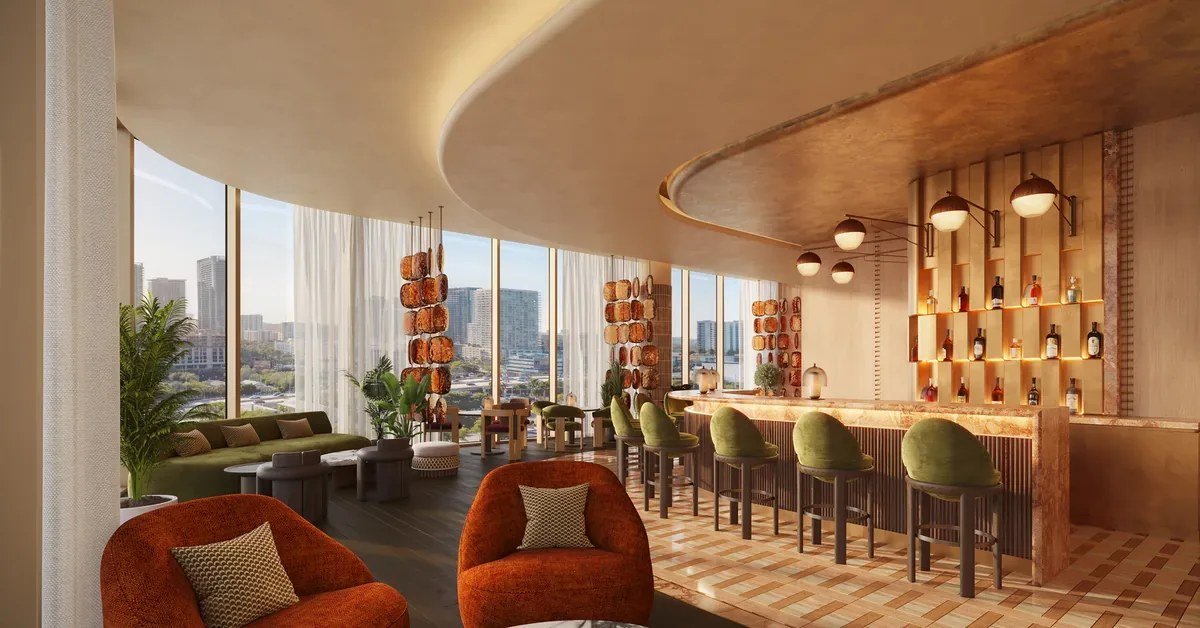
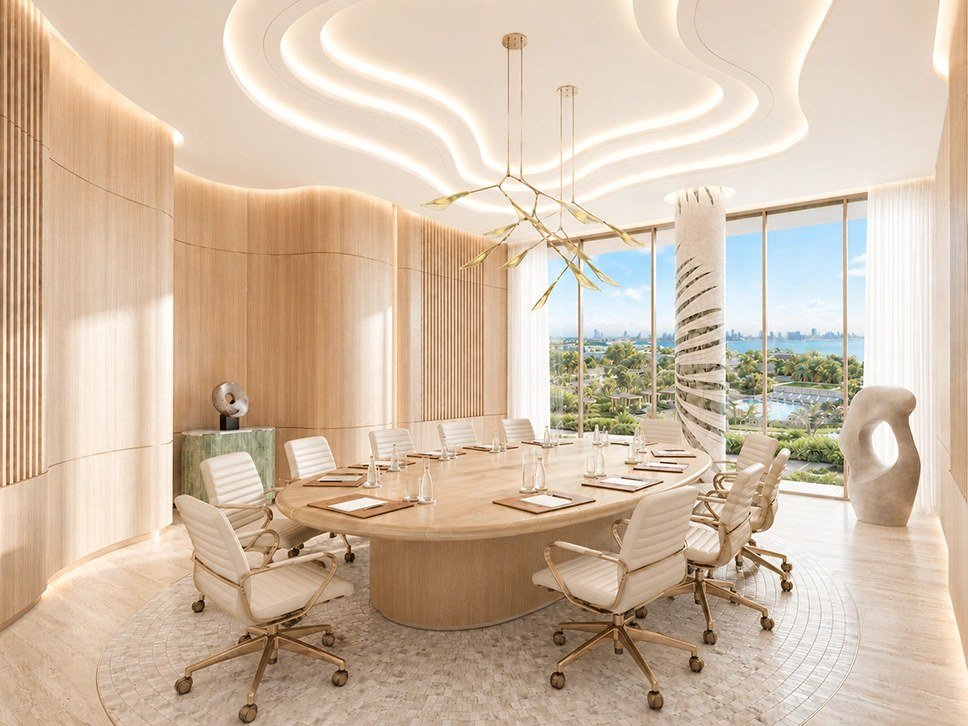
The residential lobby. Interiors are by Rockwell Group.
A great room, with the bay on two sides.
A kitchen, open to the great room.
The north tower pool deck.
A private terrace. Balconies are published at ten feet deep.
Building facts
- Address
- 3801 Biscayne Boulevard
- Neighborhood
- Miami Design District
- Year built
- Est. 2029
- Floors
- 23 (two towers)
- Residences
- 128, plus six townhomes and 20 guest suites
- Status
- Pre-construction — groundbreaking anticipated Q2 2027
- Architect
- Arquitectonica
- Pricing
- From $3.7 Million
Key Takeaways
- Two 23-storey towers, 64 residences each — 128 condominiums plus six townhomes and 20 guest suites, at 3801 Biscayne Boulevard. The height, residence count and suite count were all revised after the January 2026 launch.
- There is no hotel. This is a standalone branded residence, so the concierge, the spa, the restaurant and the two-tower amenity bridge are funded entirely by 128 households, with no hotel absorbing the overhead.
- Entry pricing is $3.7 million, against a $3.4 million top-5% luxury threshold for Miami-Dade condominiums. There is no ordinary unit in this building.
- The Design District has close to 1,000 residential units in its pipeline and almost no residential track record. Kempinski is 128 of them, at the highest entry price in the district.
- Completion is late 2029, and no construction loan has been reported — the delivery date is a statement of intent rather than a funded schedule.
Two facts about Kempinski Residences that will not appear in the same sentence anywhere else. First: entry pricing starts at $3.7 million, which means every residence in this building sits in the top 5% of the Miami-Dade condominium market before you choose a floor. Second: the Miami Design District — a neighbourhood built as a retail district, with essentially no residential track record — has close to 1,000 residential units in its pipeline. Kempinski is 128 of them, and it delivers in late 2029.
Have a question about Kempinski Residences Miami Design District? This page is built from the county record and the trade press, not a listing feed. If you want what has actually closed here, or an honest read on whether it suits you, ask me directly.
Call (305) 695-8257Email about Kempinski Residences Miami Design District
Kempinski Residences Miami Design District — the record, as of 23 August 2026
Updated 23 August 2026. The residence count, tower height and suite count were revised after the January 2026 launch. Figures here follow Florida YIMBY, 17 July 2026, and were confirmed by the project’s representatives. Kempinski’s own press room still carries the launch figures.
Miami Design District
DaGrosa Capital Development Partners
128, plus 6 townhomes and 18 resident-only suites
Two 23-storey towers, 64 residences each
Arquitectonica
Rockwell Group
2,100–3,100 sq ft, two to four bedrooms
From $3.7 million
Roughly $1,190–$1,760 depending on unit size
No — standalone branded residence
None reported by any source
Late 2029
Sources: Boutique Hotel News, 30 January 2026; The Real Deal, 6 April 2026. Price-per-square-foot figures are my calculation from the published entry price and unit-size range.
The thing to understand first: there is no hotel
Kempinski is Europe’s oldest luxury hospitality brand, and its CEO Barbara Muckermann framed the launch in January 2026 around bringing that lineage to Miami. The building carries the name. It does not carry a hotel.
This is a standalone branded residence — no adjoining hotel, no shared back-of-house, no existing operational infrastructure next door. That distinction is the single most important structural fact about this building, and it is almost never explained to buyers.
Why it matters. In a conventional branded residence — a Four Seasons, a Ritz-Carlton, a St. Regis with a hotel attached — the service you are buying already exists. There is a hotel operating next door with staff, systems, housekeeping, engineering and food and beverage, and your residence plugs into it. The economics work because the fixed cost is shared with a functioning hotel.
In a standalone branded residence, the service has to be built from nothing and paid for entirely by 128 households. There is no hotel absorbing the overhead. Everything — the concierge, the spa staffing, the restaurant, the padel court, the two-tower amenity bridge — sits on the residential association budget.
That is not a reason to avoid the building. Several standalone branded residences work extremely well, and the model has become common precisely because it lets developers put a brand on a site too small for a hotel. But it changes what you must diligence:
- What exactly is Kempinski contracted to do — is this a licence of the name, or a management agreement with staffing obligations? Get the term of the agreement and the termination provisions.
- What happens if the brand leaves? Branded residences do lose their brands. Establish whether the association can be left holding an amenity programme designed around an operator that is no longer there.
- What is the projected association fee, and what does it assume about staffing that restaurant, that spa and that bridge across 128 households rather than a hotel’s cost base?
Ask for the projected budget in writing. On a building of this type, the carrying cost is the number that surprises people, not the purchase price.
Nearly 1,000 units into a neighbourhood that has never been residential
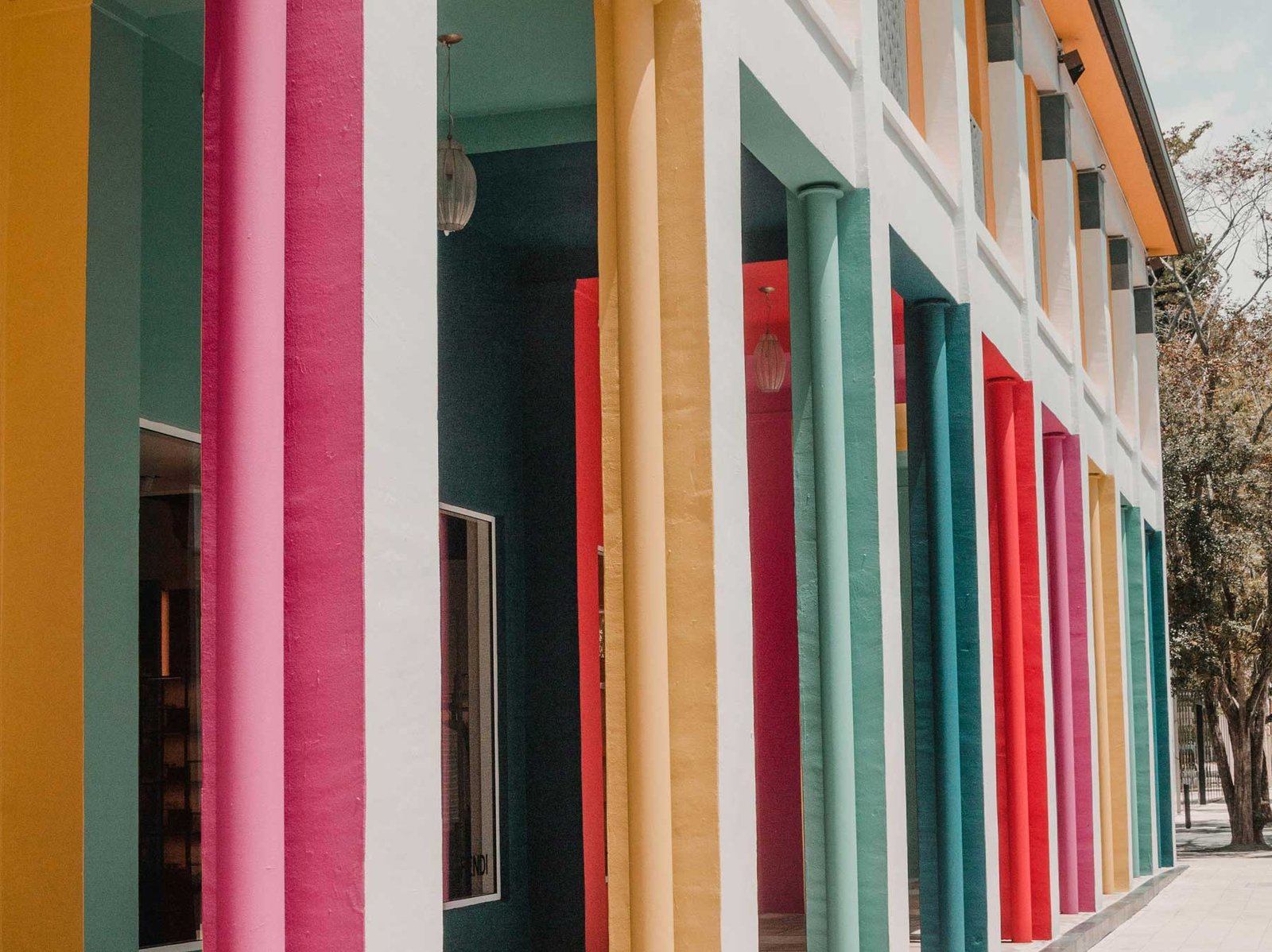
The Design District is small, and it was engineered for retail — Gucci, Louis Vuitton, Fendi, Prada. It has almost no history as a place people live. That is now changing very quickly, and the scale is worth seeing in one place:
Two readings, and both are legitimate.
The bull case: the Design District has the best luxury retail in the southeastern United States and, until now, nowhere to live. Land is genuinely scarce — as one developer put it, any low-hanging fruit is long gone — and the zoning constraints in a small, retail-focused neighbourhood mean this pipeline is close to all the supply there will ever be. Scarcity plus the strongest retail address in the region is a real thesis.
The bear case: nobody has tested whether the Design District can absorb a thousand residential units, because it has never absorbed any. The neighbourhood empties at night. There is no grocery, no school pipeline, no residential service infrastructure, and the ground-floor retail is priced for handbags rather than for households. Every one of these projects is underwriting the same untested assumption — that people want to live above the shops here — and they will all discover the answer at roughly the same time.
Kempinski is the most exposed to that question, because at $3.7 million it is asking the highest entry price in the district. Jean-Georges starts near $1 million. Miami Design Residences starts at $1.7 million. Kempinski starts more than twice as high as either.
Put the price in context
The MIAMI Association of Realtors set the luxury threshold for Miami-Dade condominiums — the top 5% of the market — at $3.4 million for the first half of 2026. Kempinski’s entry price is $3.7 million.
That means there is no ordinary unit in this building. Every residence, including the smallest, prices above the top-5% threshold for the entire county. On a per-square-foot basis the entry works out to roughly $1,190 to $1,760 depending on whether the $3.7 million buys the 3,100-foot end or the 2,100-foot end of the range — a spread wide enough that the answer to “which unit is $3.7 million?” is the first question to ask.
For comparison, the county condominium median in May 2026 was $415,000, against 12.9 months of supply. Those two markets have nothing to do with each other, and the softness in the county figure will not help you here — but it is worth knowing you are buying into the thinnest, most competitive tier of the market at a moment when the broad market is oversupplied.

Late 2029 is a long way away
This is the longest delivery horizon of any building I currently cover. From today, late 2029 is more than three years out, and no construction loan has been reported by any source.
That is normal at this stage — the project launched sales in January 2026 and a construction facility typically closes once presales hit a threshold. It is not a red flag. But it does mean the delivery date is currently a statement of intent rather than a funded schedule, and a great deal can change in three and a half years: construction costs, insurance, the brand agreement, the absorption of the other 850 units around it, and the market itself.
What I would want before committing a deposit at this horizon: where the money is escrowed and under what release schedule, the outside completion date in the contract as distinct from the marketing date, your remedies if it is missed, and the developer’s reserved right to change the unit mix, finishes and amenity programme between now and 2029.
Who actually owns the block
This is the part that is not in any of the coverage, and it took a folio-by-folio pull to find. The site is a full city block in Magnolia Park 2nd Amended, Plat Book 5 page 25, bounded by Biscayne Boulevard, NE 38th Street and NE 39th Street — eight folios and 117,766 square feet, 2.70 acres. Three of the eight are titled to the developer’s entity, Biscayne Residences Holdings LLC. The other five are not.
| Folio | Address | Owner of record | Developer’s? | Lot sq ft | On the 2026 roll |
|---|---|---|---|---|---|
| 01-3219-011-0340 | 3801 Biscayne Blvd | Biscayne Residences Holdings LLC | Yes | 50,442 | 1963 office building, standing |
| 01-3219-011-0400 | 455 NE 38 St | Biscayne Residences Holdings LLC | Yes | 9,030 | Vacant — cleared before the 2026 roll |
| 01-3219-011-0410 | 448 NE 39 St | Biscayne Residences Holdings LLC | Yes | 9,170 | Vacant — cleared before the 2026 roll |
| 01-3219-011-0420 | 446 NE 39 St | Glenroyal Investment LLC | No | 8,646 | 1936 duplex, standing |
| 01-3219-011-0430 | 444 NE 39 St | Glenroyal Investment LLC | No | 8,646 | 1921 multifamily, standing |
| 01-3219-011-0440 | 412 NE 39 St | Glenroyal Investment LLC | No | 8,646 | 1926 duplex, standing |
| 01-3219-011-0450 | 404 NE 39 St | Glenroyal Investment LLC | No | 8,646 | 1931 duplex, standing |
| 01-3219-011-0460 | 3883 Biscayne Blvd | Odarp Inc | No | 14,540 | 1973 office, retail and garage, standing |
Miami-Dade County Property Appraiser, retrieved 4 September 2026.
The developer holds 68,642 square feet — 1.58 of the 2.70 acres. Four of the remaining lots belong to Glenroyal Investment LLC, whose last recorded activity was a $100 intra-family reorganisation in November 2019. The fifth is 3883 Biscayne Boulevard itself, owned by Odarp Inc, whose last recorded sale is 1 March 1978, for $515,500. Glenroyal and Odarp share a mailing address with each other — but not with the developer.
I want to be careful about what this does and does not mean. A tax roll records deeds. It does not show options, contracts, ground leases or a closing that has not been indexed yet, and large assemblages routinely close in stages. So this is not evidence that anything is wrong. What it is: the project is marketed at “3801 and 3883 Biscayne Boulevard,” and as of 4 September 2026 the county does not record the developer as owning 3883. None of the trade coverage mentions it, because none of it checks title.
The physical state of the block matches the ownership split exactly: the two parcels the developer owns outright are already cleared, and every parcel it does not own is still standing — four occupied 1920s and 1930s multifamily buildings on NE 39th Street, and a 21,218-square-foot office, retail and garage complex at 3883.
What the land has cost so far. The March 2024 purchase was $33.6 million for 3801 Biscayne and 455 NE 38th Street, bought by Kolter Group and DaGrosa with an $11 million acquisition mortgage; the county records the two deeds at $2,500,000 and $31,300,000, which comes to $33.8 million and corroborates it. A third parcel, 448 NE 39th Street, followed for $2,650,000 in May 2024 — reported by nobody. That is about $531 a square foot of land against an assessment of roughly $148. Both March deeds are county-flagged “package or bulk sale,” so neither is a clean standalone comparable.
⚠️ One loose end worth raising with the sales team. Kolter Group was the 51 per cent buyer of that land per the mortgage documents. It is a large and experienced Florida condominium developer, and it appears in none of the Kempinski-branded announcements from January 2026 onward. Whether it is still a partner, or was bought out, is not stated anywhere I could find.
One last thing the record settles: the site is a split transect, not a uniform T6. The county assesses every T4-R lot on this block at exactly $100.00 a square foot for 2026 and every T6-12-L lot at exactly $225.00 — 68,326 square feet of the block is T4-R and 49,440 is T6-12-L, and 3801 Biscayne straddles both.
What the building actually is
Two 23-storey towers, 64 residences each, joined by an amenity bridge — a genuinely unusual move, and the most interesting architectural idea here. Arquitectonica on architecture, Rockwell Group on interiors; both are serious, and Rockwell in particular is a hospitality specialist, which is consistent with the brand.
Residences run 2,100 to 3,100 square feet across two to four bedrooms, plus six townhomes and 18 resident-only purchase suites — the suites being the detail worth asking about, since they are typically bought by residents for staff or guests and their resale market is narrow.
The amenity programme is unusually deep for 128 households: fitness centre, spa, padel court, lap pool, cold plunge, infrared and steam saunas, outdoor training area, a restaurant with terrace, a library with wine and game lounges, golf and Formula 1 simulators, screening room, children’s playroom and splash pad.
Read that list again with the association budget in mind. A restaurant and a spa are not amenities in the sense that a pool is an amenity — they are businesses, with staff, licences and losses. Across 128 households and no hotel to share the burden, someone is funding them.
Floor plans, line by line
These are the developer’s own published lines, as of 4 September 2026. Four lines per floor in each tower, 64 residences per tower. Dimensions are approximate and should be checked against the recorded declaration — which does not exist yet — before you sign anything.
North Tower
| Line | Bedrooms | Baths | Interior sq ft | Total sq ft |
|---|---|---|---|---|
| 01 Line | 3 Bed + Den | 3.5 | 2,685 | 3,240 |
| 02 Line | 3 Bed + Den | 3.5 | 2,699 | 3,240 |
| 03 Line | 2 Bed + Den | 2.5 | 2,151 | 2,597 |
| 04 Line | 2 Bed + Den | 2.5 | 2,225 | 2,715 |
South Tower
| Line | Bedrooms | Baths | Interior sq ft | Total sq ft |
|---|---|---|---|---|
| 01 Line | 4 Bed + Den | 4.5 | 3,102 | 3,687 |
| 02 Line | 4 Bed + Den | 4.5 | 3,090 | 3,679 |
| 03 Line | 2 Bed + Den | 2.5 | 2,505 | 2,970 |
| 04 Line | 2 Bed + Den | 2.5 | 2,319 | 2,798 |
The South Tower carries the four-bedroom lines and the largest plans at 3,090 and 3,102 square feet inside; the North Tower tops out at three bedrooms. The smallest published home is the North Tower 03 line at 2,151 square feet. Every line is a “plus den,” and every balcony is published at ten feet deep.
Who is Kempinski Residences Miami Design District right for?
It suits a buyer who wants large-format apartments in a genuinely scarce location, who values the Design District specifically rather than Miami waterfront generally, who is comfortable with a 2029 horizon, and who has looked at the projected association fee and found it acceptable.
It does not suit a buyer who needs delivery inside three years, who wants water views or waterfront access, who is underwriting resale in a submarket with no residential trading history, or who assumes a branded residence comes with hotel-grade service subsidised by a hotel. It does not.
My read
The design team is excellent, the apartments are large in a market that keeps shrinking them, and the land-scarcity argument for the Design District is real rather than promotional.
Three things I would resolve in writing before committing. The Kempinski agreement — licence or management, term, termination, and what happens to the amenity programme without them. The projected association fee — specifically what it assumes about operating a restaurant and spa across 128 households with no hotel behind it. And the 2029 date, which is unfunded today and a long way out.
None of those is a reason not to buy. All three are reasons not to buy on the brochure.
If you are considering this building, tell me the unit and the budget and I will give you the same read — including if the answer is that a different building serves you better.
Related: The Miami Confidential · The Miami Pre-Construction Delivery Tracker · All Miami new construction · ONE Park Tower by Turnberry
Kempinski Residences Miami Design District — common questions
When will Kempinski Residences Miami Design District be completed?
Late 2029. That is the longest delivery horizon of any building I currently cover — more than three years from now — and no construction loan has been reported by any source. That is normal for a project that launched sales in January 2026, but it means the date is a statement of intent rather than a funded schedule.
How much do residences at Kempinski Miami cost?
From $3.7 million, across units of 2,100 to 3,100 square feet in two- to four-bedroom configurations. That works out to roughly $1,190 to $1,760 per square foot at the entry price depending on unit size. For context, the MIAMI Association of Realtors put the Miami-Dade luxury condominium threshold — the top 5% of the market — at $3.4 million for the first half of 2026, so every residence in this building prices above that threshold.
Is there a Kempinski hotel at the Miami Design District residences?
No. This is a standalone branded residence with no adjoining hotel — the most important structural fact about the building. In a conventional branded residence the service already exists next door and the fixed cost is shared with a functioning hotel. Here it must be built from nothing and funded entirely by 128 households. Establish whether Kempinski’s involvement is a name licence or a management agreement with staffing obligations, and what happens if the brand departs.
Who is developing Kempinski Residences Miami?
DaGrosa Capital Development Partners LLC. Arquitectonica is the architect and Rockwell Group designed the interiors. The project comprises two 23-storey towers of 64 residences each, joined by an amenity bridge, plus six townhomes and 18 resident-only purchase suites.
How many residential units are planned for the Miami Design District?
Close to 1,000 across five projects: Jean-Georges Miami Tropic Residences (338), The Helm (162 branded condos plus 116 apartments), Miami Design Residences (143 plus an 85-key hotel), Kempinski Residences (128) and Cassi (107 rental). The Design District was built as a retail neighbourhood and has essentially no residential track record, so absorption at this scale is untested.
Is the Design District a good place to buy a condo?
It depends which risk you are more comfortable with. The bull case is genuine land scarcity in the strongest luxury retail address in the southeastern United States, with zoning constraints meaning this pipeline is close to all the supply there will ever be. The bear case is that nearly 1,000 units are being underwritten on the same untested assumption — that people want to live above the shops — in a neighbourhood with no grocery, no residential service infrastructure and streets that empty at night.
What amenities does Kempinski Residences Miami have?
Fitness centre, spa, padel court, lap pool, cold plunge, infrared and steam saunas, outdoor training area, restaurant with terrace, library with wine and game lounges, golf and Formula 1 simulators, screening room, children’s playroom and splash pad, plus an amenity bridge connecting the two towers. Worth noting that a restaurant and a spa are businesses rather than amenities — with staff, licences and operating losses — funded across only 128 households and with no hotel to share the cost.
Sources and further reading
- Boutique Hotel News — Kempinski reveals standalone branded residence project in Miami, 30 January 2026boutiquehotelnews.com
- Florida YIMBY — New renderings reveal interiors and amenity spaces at Kempinski Residences Miami Design District, 17 July 2026floridayimby.com
- The Real Deal — Miami’s Design District has 1,000 resi units in the pipeline, 6 April 2026therealdeal.com
- MIAMI Association of Realtors — South Florida Luxury Home Market Reaches New Milestones, 23 July 2026miamirealtors.com
- MIAMI Association of Realtors — Miami-Dade market report, May 2026prnewswire.com
- Kempinski Residences Miami Design District — official project website (retrieved 4 September 2026)kempinskidesigndistrict.com
- Miami-Dade County Property Appraiser — Property Search (folios 01-3219-011-0340, -0400, -0410, -0420, -0430, -0440, -0450 and -0460, retrieved 4 September 2026)miamidadepa.gov
- Commercial Observer, 29 March 2024 — “Kolter and DaGrosa Buy Property Near Miami Design District for $34M”commercialobserver.com
- Kempinski Group press room, 30 January 2026 — “Kempinski Residences Miami Design District Marks U.S. Debut for Kempinski Residences”kempinski.com
Thinking about Kempinski Residences Miami Design District?
I have sold South Florida property since 2002, more than $1 billion of it. Ask me for the recorded declaration, what has genuinely closed, or a straight answer on whether this building fits what you are after.
Call (305) 695-8257Send me a question
Josh Stein · Florida real estate sales associate, license SL3057661 · (305) 695-8257 · hello@joshsteinrealtor.comRelated coverage
Part of South Florida New Construction.
Get this building’s next recorded sale — before the listing sites catch up
- Every closed sale we can verify from the Miami-Dade record — price, date, and $/sqft when the deed supports it — not an IDX feed.
- Optional alert when a new deed posts in this building (or a short list of comps you choose).
- No spam inventory blasts. One building. One record. You decide what happens next.
Tell Josh which building. He’ll send the latest closed sales and set a quiet alert.