

In Coral Gables, 83% of waterfront transactions closed for cash — 64 of 77. Above $13 million, the figure is 100%, across 14 sales. A $5.25 million house on North Greenway Drive went under contract in under one day. Meanwhile 309 homes sit available against 585 closings in a year. Both of those things are true at once, and understanding why is the whole game here.
Coral Gables single-family — Q1 2026
Source: David Siddons Group Coral Gables market report, Q1 2026. Figures dated as published.
The number that explains this market: cash
Most analysis of the Gables talks about inventory. Six months of supply, 309 homes available, 585 closings behind it — on paper that reads balanced, and on paper the correct conclusion would be that buyers have room to negotiate.
That conclusion is wrong at the top of this market, and the reason is that the top of this market does not use mortgages. Eighty-three percent of Coral Gables waterfront transactions closed all cash. Above $13 million, every one of fourteen sales was cash. A buyer paying cash is not waiting on an appraisal, is not exposed to a rate move, and has no financing contingency to give you leverage over. That is why a $5.25 million house on North Greenway Drive went under contract in less than a day, and why 1212 Sorolla Avenue closed at $7.8 million in January 2026 after roughly a week on the market.
The 309 sitting homes are real. They are just not the same houses. What sits in Coral Gables is over-improved inland product, awkward lots, and anything priced off a comparable from a different enclave. What moves is correctly priced product in the enclaves people actually want, and it moves fast and in cash.
Coral Gables is eight markets, and the spread is enormous
The single most common mistake buyers make here is treating “Coral Gables” as one price. Q1 2026 price per square foot by waterfront enclave:
Gables Estates trades at roughly three times east-of-US1 resale. Same city, same schools, same tax roll. If your agent is pulling comparables across that boundary, the number they hand you is meaningless.
Ten years of it, so you can see the trend rather than the snapshot
Between 2016 and 2026, price per square foot moved as follows:
- Gables Estates / Old Cutler Bay: $1,185 → $3,100 — +162%
- Cocoplum waterfront: $600 → $1,650 — +175%
- East of US-1 resale: $456 → $1,050 — +130%
- New construction, non-waterfront: $550 → $1,200 — +118%
Two things are worth reading out of that. First, everything in Coral Gables more than doubled — this is not a market where one segment ran and the rest stalled, which is precisely what happened in Coconut Grove. Second, the fastest growth was Cocoplum, not the most expensive enclave. Gated waterfront that was not yet trophy-priced in 2016 has closed most of the gap. That pattern is worth watching in Gables by the Sea and Sunrise Harbour now, which sit at the bottom of the waterfront table today.
What Coral Gables actually sells you
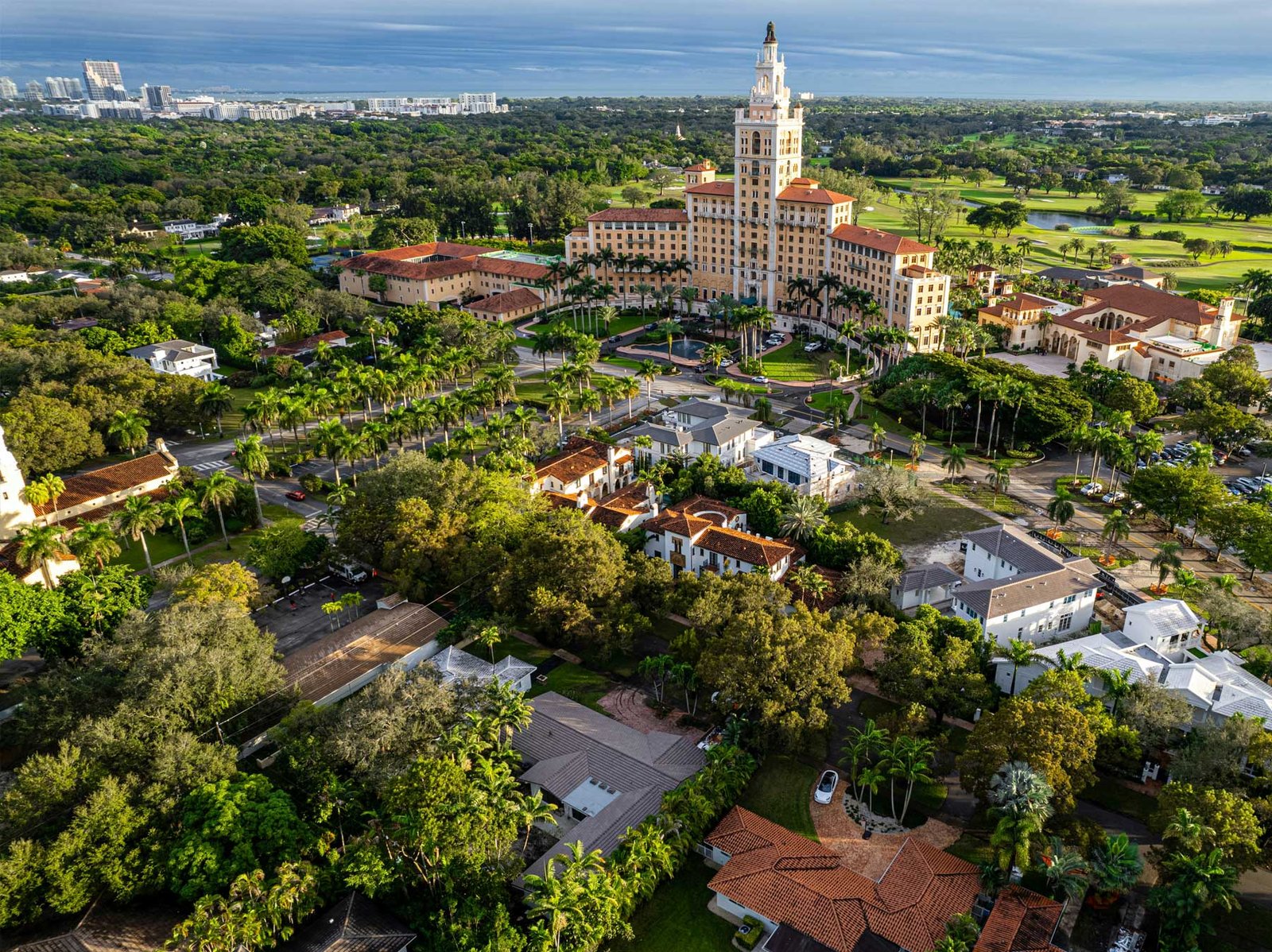
Every luxury neighbourhood in Miami claims to protect value. Coral Gables is one of the few that has the machinery to do it. The Board of Architects reviews exterior work. Barrel tile, façade treatment, setbacks and colour are governed. The tree canopy is protected. There is no realistic scenario in which a glass box appears next door to a 1926 Mediterranean house.
That is the product. It costs you flexibility — renovations take longer and cost more, and some things you want will simply be refused — and it buys you the near-certainty that the street you bought on will look the same in twenty years. For a certain buyer that trade is obviously correct. For a buyer who wants to build something contemporary and large, it is obviously wrong, and the Grove or Pinecrest is the better answer.
The gated waterfront — Gables Estates, Old Cutler Bay, Cocoplum, Tahiti Beach, Snapper Creek
Deep water, ocean access, guard gates, and in several cases club membership and board approval as a condition of purchase. These are the addresses producing the cash transactions above. Supply is fixed and the boards are not friendly to change. Expect an approval process, and expect to be underwritten personally, not just financially.
South Gables and the Biltmore corridor
The trophy inland market at $2,000 and $1,700 per square foot respectively. Large lots, the best of the 1920s architecture, and the streets people picture when they picture Coral Gables. No water, and no discount for the absence of it — this is where the architecture premium is most visible.
East of US-1 and the village core
Resale at $1,050 per square foot, new construction at $1,200. Walkable to Miracle Mile, smaller lots, older stock, and by a distance the best value entry into the city. Also the segment where over-improvement is most common and most punished at resale.

Six things to check before you buy in Coral Gables
1. Board of Architects scope. Before you buy on the assumption you will renovate, establish what is actually approvable on that specific property. Roof material, window profile, façade changes and additions are all governed, and “the last owner did it” is not evidence that you can.
2. Which enclave the comparables came from. A $1,650 Cocoplum comparable applied to a Sunrise Harbour house at $1,300 overstates value by a quarter. Insist on comparables from inside the same enclave.
3. Gated community approval. Gables Estates and several neighbours require board approval and, in some cases, club membership. That is a process with a timeline and a possibility of refusal. Understand it before you go hard on a deposit.
4. Whether you are competing against cash. If the house you want is waterfront, assume your competition is not financing. Structure accordingly — shorter inspection periods and proof of funds matter more than your offer price at the margin.
5. Canopy and specimen trees. Protected trees constrain footprint, pool siting and driveway placement. Establish the tree survey before you plan a build.
6. Elevation, seawall and dock. On any waterfront lot: elevation certificate, seawall condition and remaining life, dock permit status, water depth at low tide, and clearance to open water. Each of these can move value by seven figures.
How I work in Coral Gables
I have been selling in Miami since 2002 and I will tell you when a Gables house is priced off the wrong enclave — including when the right answer is to buy east of US-1 and put the difference into the house. The standard I apply in The Miami Confidential applies here: dated figures, named sources, and an honest read even when it costs me the transaction.
Related: Miami Luxury Homes — the county-wide picture · Coconut Grove Homes · Miami Waterfront Homes · Coral Gables neighbourhood guide
Coral Gables homes — common questions
How much does a house cost in Coral Gables in 2026?
It depends entirely on the enclave, and the spread is roughly three to one. In Q1 2026, resale east of US-1 ran about $1,050 per square foot and new non-waterfront construction about $1,200, while Gables Estates reached $3,100 and Old Cutler Bay $2,800. Cocoplum sat at $1,650, Tahiti Beach at $1,800 and Snapper Creek at $2,000.
Is Coral Gables a buyer’s or seller’s market?
Citywide it reads balanced — roughly six months of supply, with 309 homes available, 53 under contract and 585 closings in the trailing twelve months. But that average conceals the split: correctly priced waterfront moves in days and in cash, while over-improved or mispriced inland product sits. Treating the citywide figure as your negotiating position is a mistake at the top of the market.
Why do so many Coral Gables homes sell for cash?
Eighty-three percent of Coral Gables waterfront transactions closed all cash in the reporting period — 64 of 77 — and above $13 million the figure was 100% across 14 sales. Cash buyers have no appraisal risk, no rate exposure and no financing contingency, which is why a $5.25 million house on North Greenway Drive went under contract in under a day.
How much have Coral Gables home values risen over ten years?
Between 2016 and 2026, price per square foot rose 162% in Gables Estates and Old Cutler Bay ($1,185 to $3,100), 175% in Cocoplum waterfront ($600 to $1,650), 130% for resale east of US-1 ($456 to $1,050), and 118% for non-waterfront new construction ($550 to $1,200). Unusually, every segment more than doubled.
What is the Coral Gables Board of Architects and does it affect buyers?
It reviews exterior work in the city — roof material, façade treatment, window profile, colour, setbacks and additions. It is the reason Coral Gables streetscapes hold their character, and it is also a real constraint on renovation. Establish what is approvable on a specific property before buying on the assumption you will change it.
Which Coral Gables neighbourhoods are gated?
Gables Estates, Old Cutler Bay, Cocoplum, Tahiti Beach, Snapper Creek and Hammock Lakes are the principal gated waterfront enclaves. Several require board approval, and in some cases club membership, as a condition of purchase — a process with its own timeline and the possibility of refusal.
Is Coral Gables or Coconut Grove the better buy?
They behave differently. Every Coral Gables segment more than doubled over ten years, whereas in Coconut Grove the waterfront ran hard while the inland trophy ceiling stayed flat at roughly $2,150 per square foot for three years. Coral Gables offers more predictable appreciation across segments and stronger architectural protection; the Grove offers walkability and the higher waterfront ceiling.
Sources and further reading
- David Siddons Group — Coral Gables Real Estate Market Report, Q1 2026luxlifemiamiblog.com
- David Siddons Group — Coconut Grove Real Estate Market, Q1 2026luxlifemiamiblog.com
- MIAMI Association of Realtors — Miami-Dade market report, May 2026prnewswire.com
Start here
The main sections of The Miami Confidential.